
Building Mirrago: How Virtual Try-On Technology Turned a Personal AI Sandbox Into a Scalable E-Commerce Platform in 30 Days
The particular kind of frustration every online shopper knows: you fall in love with a dress on your screen, order it with hope, and then unbox disappointment. The fit is wrong. The drape doesn't sit the way it did in the photo. Back it goes, another box in the $890 billion pile of U.S. retail returns in 2024 alone.
I didn't just want to read about this problem. I wanted to solve it.
Every engineer eventually looks for a meaningful challenge, a real-world problem that is complex, impactful, and still waiting for the right technological solution. After spending years architecting large-scale systems and LLM infrastructure, I wanted to get my hands dirty and build something end-to-end. I found mine in the e-commerce "fit" crisis: up to 30% of all online clothing purchases are returned, simply because shoppers cannot visualize how a garment will actually fit their unique bodies.
This is the story of how virtual try-on technology and a lot of stubborn late nights turned Mirrago from a quiet technical sandbox into a dual-sided AI fashion discovery platform and B2B SaaS infrastructure.
Phase 1: The Quiet Groundwork Behind Virtual Try-On Technology
Before there was a platform, there was a personal passion project. Long before I focused on Mirrago full-time, I spent my nights and weekends deep in academia, chasing a problem most people had quietly given up on.
The goal was incredibly complex: realistically overlay clothes onto a human body photo while preserving the garment's exact texture, drape, and patterns. Because the readily available AI models were trained almost entirely on upper-body data, generating accurate full-body overlays was a massive hurdle. I had to roll up my sleeves and dive into fine-tuning custom models using the following:
Weighted training to correct the upper-body data bias
Supervised Fine-Tuning (SFT) to teach the model garment-specific texture and drape
Countless iterations of trial, failure, and retraining, the unglamorous part nobody posts about
It was a grind, but those early experiments built the foundational technical moat that Mirrago's virtual try-on technology runs on today.
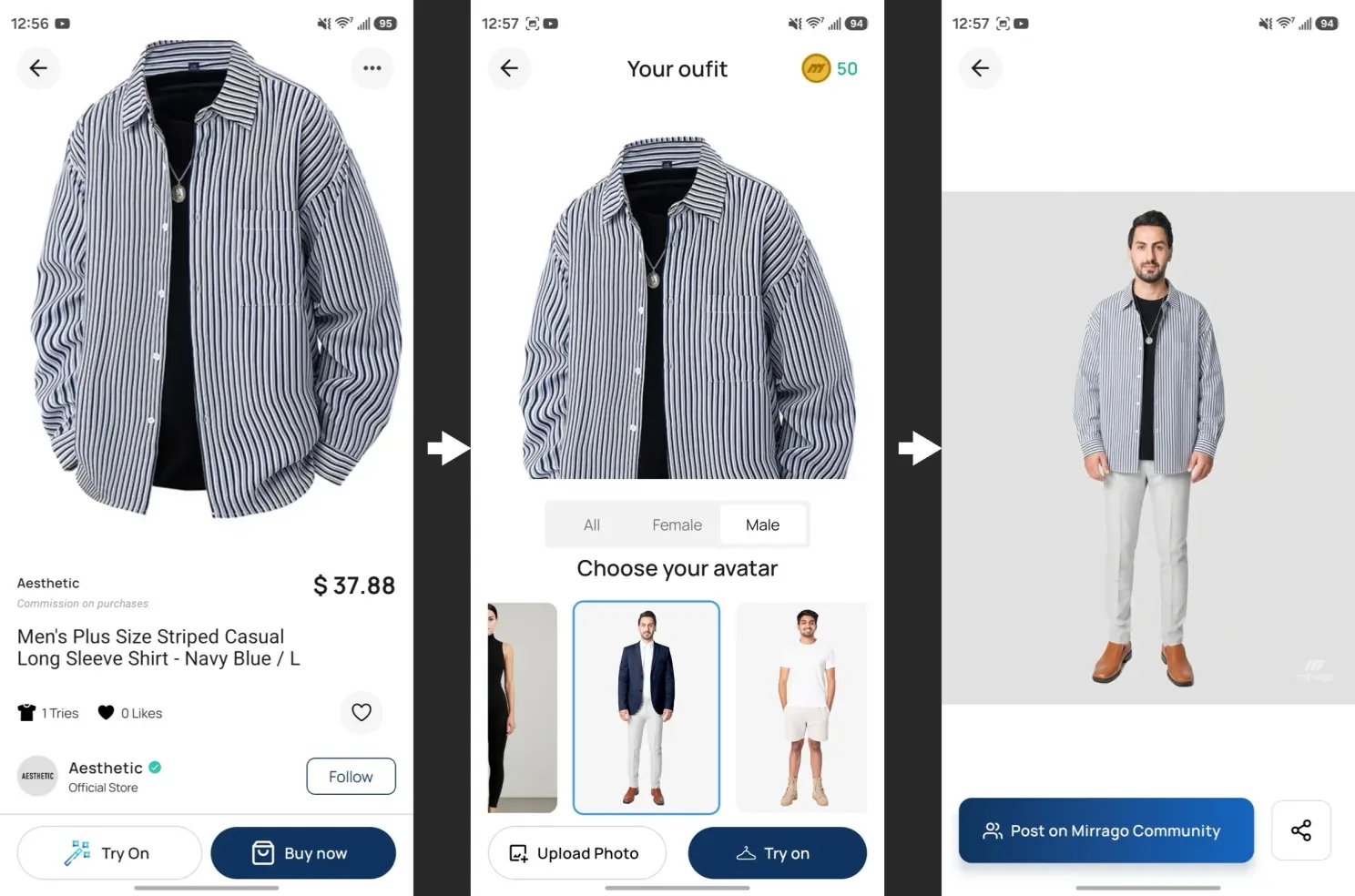
The "Aha" Moment: Pragmatism Over Ego
As I was grinding on model fine-tuning, the AI landscape shifted. New, high-efficiency vision-language models (VLMs) and multimodal LLMs hit the market.
As an engineer, it is deeply tempting to keep obsessing over your own custom algorithms. But as a founder, you have to optimize for product value. I made the pragmatic call to pivot. By leveraging these new models to handle the core visual generation, I freed myself up to focus on what actually turns a cool AI trick into a scalable company: the infrastructure and the business model.
The market data validated this shift:
71% of consumers say they would shop more often with brands offering AR try-ons
Retailers implementing virtual fitting rooms saw conversion rates rise by up to 50%
The same technology slashed expensive returns by up to 40%
The math was clear. Mirrago didn't just need to be a try-on utility; it needed to be scalable virtual try-on technology powering real e-commerce infrastructure.
Phase 2: The 30-Day Bootstrapped Sprint
Earlier this year, I stepped away from my day-to-day engineering leadership job to give Mirrago my undivided attention. We had the AI capabilities; now we needed a business.
Within one single month, I completely pivoted the app into a full-fledged fashion discovery platform.
Building an ecosystem of this scale usually requires a massive engineering team and a bottomless cloud budget. As a bootstrapped founder, I had neither. I couldn't just throw expensive cloud compute at our scaling bottlenecks; I had to engineer our way out of them. By coding directly alongside AI agents to multiply my output, I productionized a massive system architecture in just four weeks.
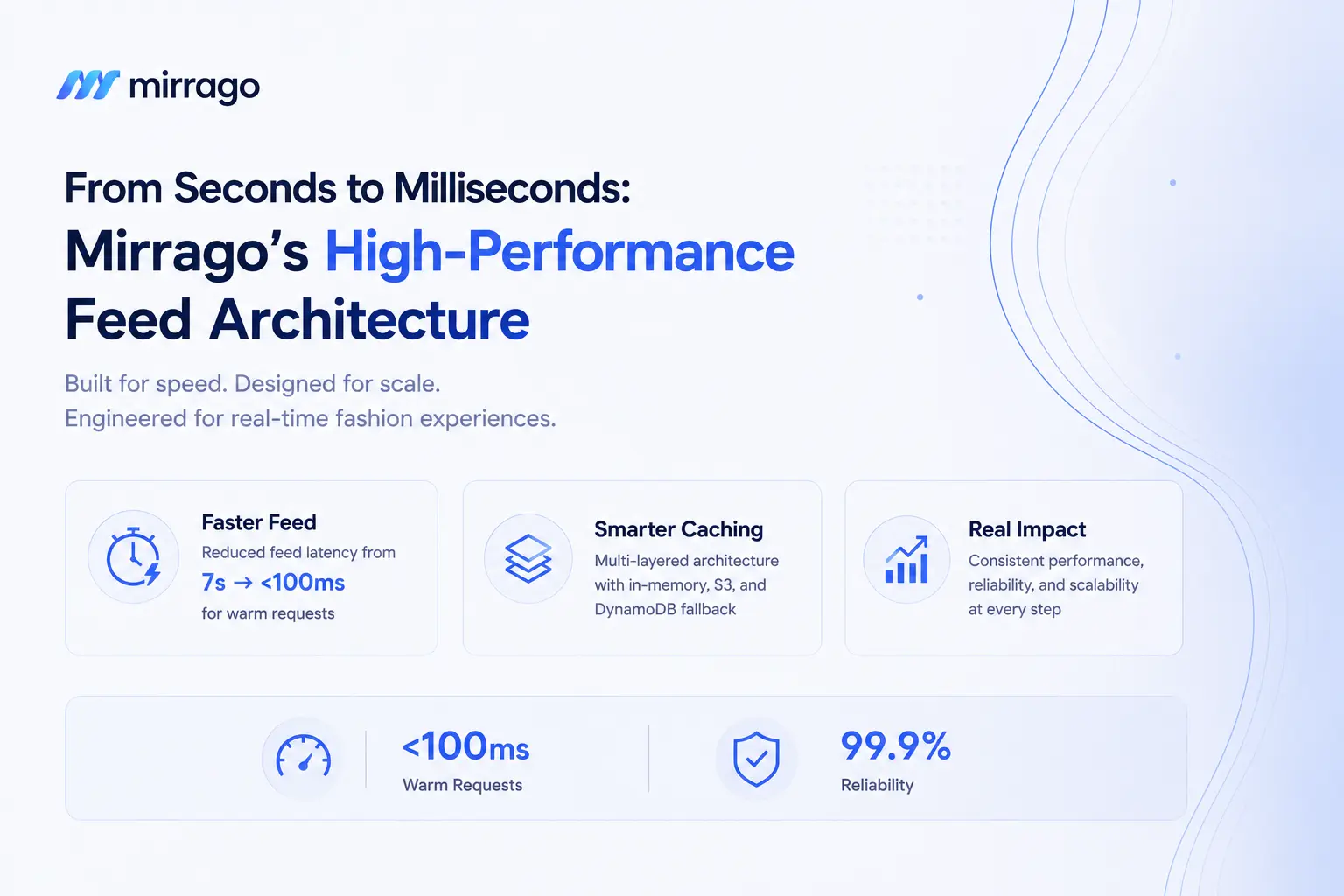
Slashed latency on a budget:
Problem: Cold starts and database scans were causing our feed to load in 5 to 7 seconds
Solution: Built an EventBridge keep-warm rule and re-architected services with a multi-layered cache, backing an in-memory dictionary with S3 gzip blobs and a "stale-while-revalidate" pattern instead of paying for costly AWS Provisioned Concurrency
Result: Feed latencies dropped to sub-100ms on warm requests, for pennies
Lightning-fast search:
Problem: Searching our catalog of over 25,000 affiliate products via database table scans caused 2–5 minute hangs
Solution: Built a parallelized, in-process inverted index that updates in the background
Result: Unified search results now deliver in under 50 milliseconds
Phase 3: Opening the Ecosystem
To build a sustainable, capital-efficient company, we engineered a dual-engine model.
On the consumer side, we launched a discovery feed integrated with premium global affiliate networks. Users can now discover trending styles, see exactly how they look on their own bodies, and buy instantly from global brands.
But to truly make a dent in that $890 billion return problem, we couldn't keep the tech to ourselves. We packaged our infrastructure and launched our B2B Developer APIs (developer.mirrago.com). Using a tiered SaaS model, third-party fashion brands can now easily embed the Mirrago virtual fitting room directly into their own websites. We are already piloting these integrations with a select cohort of forward-thinking fashion brands, and we are in the early stages of launching a native WordPress plugin to make integration completely seamless.
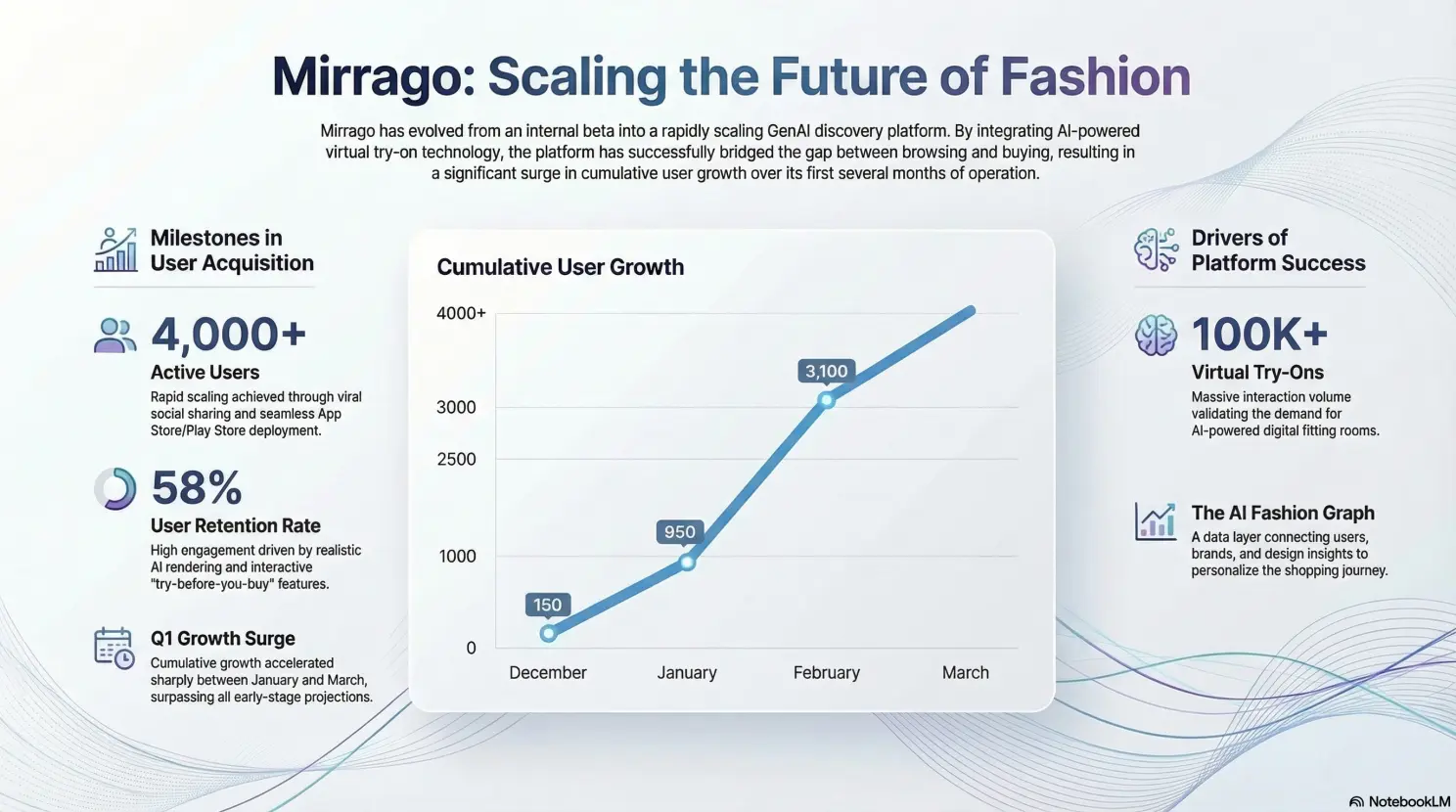
The Road Ahead
Building Mirrago has been a masterclass in designing for scale, leading a product from 0 to 1, and balancing deep-tech AI research with rapid, cost-constrained product execution.
We are building the AI Fashion Graph, a data layer connecting users, brands, and styling insights globally. As we continue to scale, I'm opening the floor for collaboration:
To consumers:
Download the Mirrago app on iOS or Android today. Explore the catalog, see how the latest styles look on you, and share your feedback with us. We are constantly iterating based directly on what our community wants to see next.
To retailers and brands:
If you are looking to cut your return rates and boost conversions through our B2B APIs or upcoming WordPress plugin, let's talk. You can explore our B2B APIs and seamless integration options at developer.mirrago.com to transform your online store.
To the tech community:
I am incredibly passionate about taking AI products from 0 to 1. I'm always open to connecting with forward-thinking founders and engineering teams who are navigating complex scaling challenges and looking to bridge deep-tech research with rapid, capital-efficient product execution.
I still think about that moment of unboxing disappointment, the mismatched fit, the returned box, and the trust that quietly erodes every time it happens. That's the moment virtual try-on technology is built to erase. We're not there yet for every shopper, every brand, every garment. But we're closer than we were 30 days ago and closer still than we were in those early nights of academic trial and error.
The future of fashion is augmented, and we are just getting started.
About the Author
Dinesh Rauniyar is the founder of Mirrago and an engineering leader & systems architect with 15+ years of experience in durable execution and AI infrastructure, including work on Alexa Smart Home (LLM/ML) systems. He specializes in Java, Python, and building large-scale distributed systems and has spent the past year applying that expertise to solving the e-commerce fit and returns crisis through virtual try-on technology.