Why Online Returns Are Becoming a Big Problem for Fashion Businesses
At first, everything looked great. Customers are buying shipments as they leave the warehouse, and sales numbers are climbing.
Then the returns start arriving. A few weeks later, the revenue you celebrated began to shrink, revealing the true cost behind those sales.
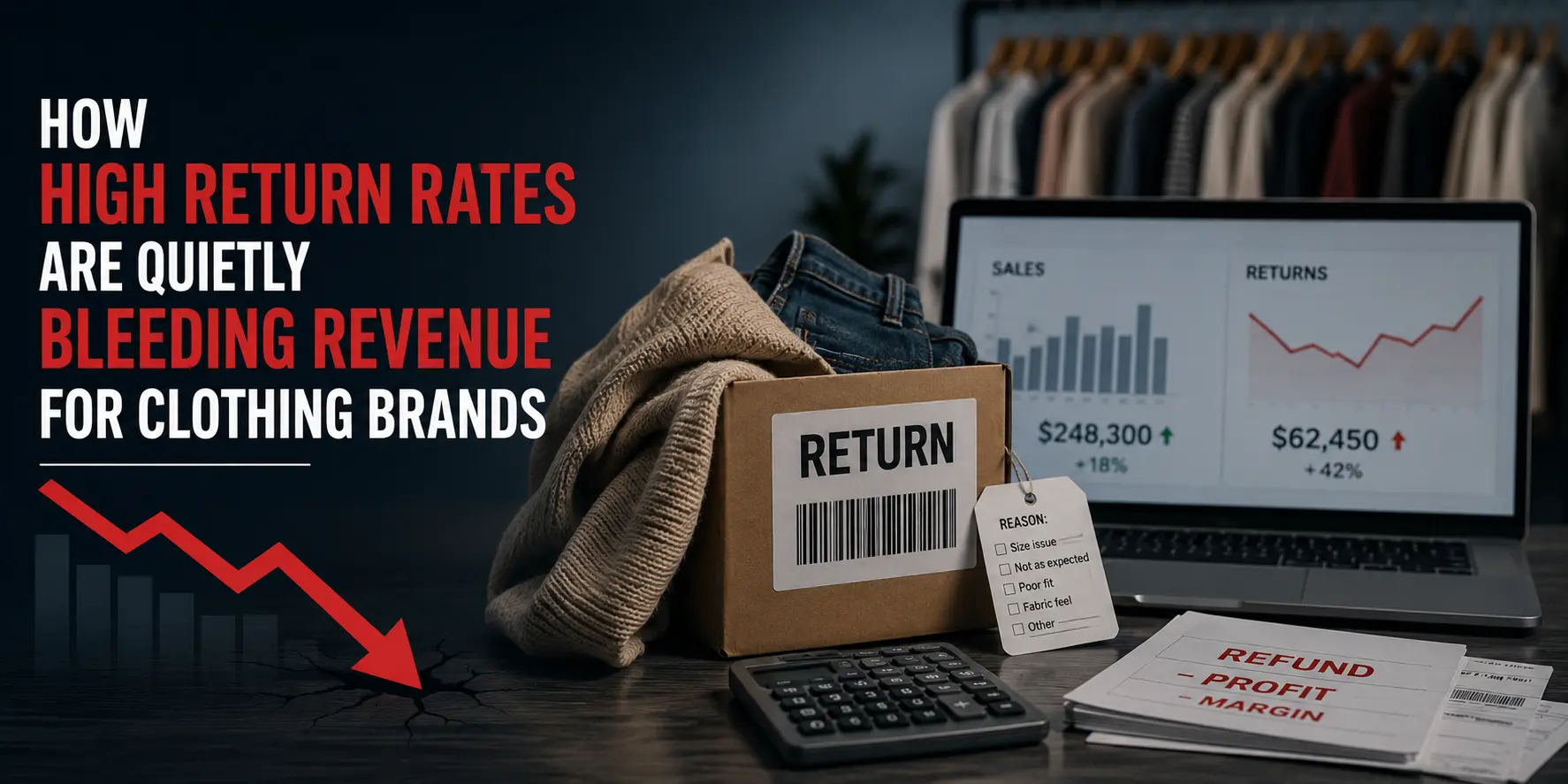
This is exactly how high return rates are silently destroying fashion brands' profits from the inside. The National Retail Federation puts the number of items consumers sent back in 2024 at a whopping $890 billion. But fashion is at the heart of the issue. Bringing in its own 26% return rate, which is 6% higher than that of shoes, electronics, and all other e-commerce categories, clothing is the most commonly returned item.
The brands seeing the most bleed simply do not view returns as a business problem yet. This is one of the fundamental explanations for why a clothing brand would lose all its sales online, despite having a tremendous number of visitors. There is nothing that says a clothing brand loses all of its sales on the web, but only that it is oozing profit out the back door.
The Real Reasons Behind High Return Rates in Apparel
When it comes to online fashion shopping, it's basically a game of speculation for the shopper.
They have no hands to touch or try it on themselves and cannot see how the garment looks on themselves. The object is boxed up when the guess is not correct. Let's look at the 4 most frequent reasons that occur.
1. Looks Are Inconsistent Across the Entire Industry
Consistency doesn't exist in fashion. A style that works in one brand looks completely different in another. What you see modeled on a product page is rarely what you actually get.
To guard themselves against this confusion, customers adopt a strategy that involves purchasing the same product in multiple variations, selecting the one that looks right, and returning the rest. In fact, this is a common practice that is used by many people in online shopping, especially in the USA, Australia, India, and Nepal, where it has almost become the standard. (Synctrack, 2025)
Why does this keep hurting your business:
Across the fashion industry, 30 to 40% of online purchases end up being returned, with sizing driving the majority (Amra & Elma, 2025)
Every returned box costs your brand $15 to $30 to process, covering two-way shipping, inspection, cleaning, and restocking labor
Bracketing artificially inflates your revenue for 2 to 3 weeks before the return wave quietly arrives and reverses it
While returned items sit in transit, that stock cannot be listed or sold, meaning you miss your peak seasonal demand window entirely
2. The Expectation vs Reality Problem Behind Online Shopping Returns
Studio photography aims to highlight the best in clothing and to produce the best possible photographs produced. However, when the package opens, and the dress doesn't look remotely like the picture, the customer feels nothing but duped.
They are less vibrant in color. The cut is different. The texture of the fabric is nothing like the image indicated. One of the most frequent and most harmful return reasons in fashion ecommerce is the gap between the online promise and what ends up at the door.
Why does this keep hurting your business:
Heavily edited product photos create expectations that real garments simply cannot meet when they arrive at the doorstep
Color discrepancies between screen display and actual fabric are a leading cause of "not as described" return claims
Customers who feel misled by photography do not just return the item; they leave negative reviews and rarely purchase again
This trust damage compounds over time; each misleading image adds to a growing pool of disappointed customers who warn others
3. Flat Photos Cannot Show How Clothes Actually Look a Real Body
A single static image on a ghost mannequin or a flat surface tells a shopper almost nothing about how a garment will actually feel to wear. How does it drape? How does it stretch? Does it pull across the shoulders or gap at the waist on a body that is not a studio model?
Without those answers, the buyer is making a completely blind purchase. And blind purchases are returned. According to Shopify Plus, some apparel markets face return rates as high as 50% largely because customers cannot visualize the looks before committing to the purchase.
Why does this keep hurting your business:
Single-angle photography hides drape, movement, and body proportion. The exact variables shoppers need to feel confident before buying
Shoppers who cannot visualize looks on their own body shape will either avoid the purchase entirely or buy defensively, already planning the return
Online shoppers return items at nearly three times the rate of in-store shoppers because physical stores allow natural try-before-you-buy filtering (Investopedia via Meteorspace, 2025)
The wider the gap between what photography shows and what a shopper needs to see, the higher the return rate climbs
4. Shoppers Cannot Feel the Fabric, and That Gap Is Costing You
No shopper can press their fingers against a phone screen and feel whether a fabric is soft or stiff, light or heavy, breathable or synthetic. They cannot test the stretch of a waistband or check the weight of a material before buying it. They have to guess.
And when that guess is wrong, the item comes back. Premium-priced items suffer the most. A shopper paying a high price expects high-quality material. When the garment arrives, and the fabric feels thin, rough, or disappointing, the return is immediate, along with the permanent loss of that customer's trust.
Why does this keep hurting your business:
When fabric quality cannot be verified before purchase, shoppers automatically assume the lowest possible quality to protect their money
Premium brands lose pricing power because the gap between what is promised and what is felt upon arrival destroys perceived value
Returns driven by fabric disappointment carry an additional layer of damage. The customer feels deceived, not just inconvenienced
This problem intensifies with the price point. The higher the ticket, the higher the expectation, and the harder the fall when the fabric disappoints
Why High Apparel Return Rates Are Quietly Destroying Your Margins from the Inside
Most brand owners think a return simply cancels a sale. It does not. It costs real money on top of the refund every single time.
According to Pitney Bowes, processing a single return swallows an average of 21% of the total order value, which silently eats up to 30% of your gross profit. And logistics audits by Cahoot.ai show that reverse shipping, restocking labor, and inventory depreciation can consume up to 65% of an item's original retail value in a worst-case return scenario
Here is what that actually looks like on a single $100 return:
Cost Item | Amount | What It Covers |
Lost sale revenue | -$100 | Full refund issued to the customer |
Two-way shipping | -$15 | Outbound delivery + return courier |
Inspection and labor | -$5 | Opening, checking, re-folding |
Steaming and re-bagging | -$3 | Cleaning and preparing for resale |
Total cash lost | -$23 | You lost $23 of your own money |
One returned item can wipe out the net profit of three successful sales. And online returns increased 39.2% from 2023 to 2024, meaning this problem is getting worse every single year, not stabilizing.
The Uncomfortable Truth: High Return Rate Problem in Fashion
Independent fashion brands are competing on a playing field they did not design and cannot control.
Large fast-fashion platforms built their entire business model around free, frictionless, no-questions-asked returns. That expectation has now carried over to every online clothing purchase, including yours. Shoppers no longer see returning as an exception. They see it as a built-in part of the shopping process that they are fully entitled to use.
According to the Best Colorful Socks Fashion Data Report, a staggering 88% of consumers have returned at least one clothing item. And in some markets, clothing return rates already exceed 50% (ClickPost, 2026).
The result is a market where independent brands absorb massive operational hits, two-way freight, inspection labor, restocking costs, and lost seasonal windows just to survive inside a consumer's expectation they had no part in creating.
Why the Return Problem Keeps Getting Worse
Here is what makes this problem particularly destructive: it does not stay the same. It compounds.
Every return creates a dissatisfied customer. A dissatisfied customer either never buys again or buys again with even more caution, ordering more sizes, hedging more aggressively, and generating more returns on the next order. Industry data shows that over 60% of shoppers who experience a poor return cycle never buy from that brand again.
Meanwhile, your reverse logistics costs are growing. Your inventory gets frozen in transit. Your seasonal stock misses its peak window. Your Customer Acquisition Cost climbs because you are paying to replace customers who have been permanently driven away by poor return experiences.
The brands most at risk are not the ones with the worst products. They are the ones where this cycle has been running quietly in the background, untracked, unmeasured, and growing. while the sales dashboard shows numbers that look fine on the surface.
Conclusion
High return rates in apparel are not a shipping problem. They are not a logistics problem. They are a symptom of a deeper structural failure happening much earlier in the customer journey, one that does not show up on your returns report until the damage is already done.
Every returned box is a shopper telling you something went wrong before they ever click Buy. The sizing confused them. The photos misled them. The fabric surprised them. The looks did not match what they imagined.
Until those root causes are understood fully, the return cycle will keep running, and the marginal damage will keep compounding quietly behind every sales notification your dashboard celebrates.
As we covered in our full guide on why clothing brands are losing online sales in the digital era, high return rates are just one of five structural leaks quietly draining fashion brand profitability.
Is your store bleeding revenue through returns?
Let's Fix It Together