As fashionHow AI Solves the Biggest Challenges in Fashion eCommerce
Shopping for online clothes should be easy. But for many customers, one question stops them from clicking "Buy Now": "Will this actually look good on me?" When they can't answer that question, they often leave without making a purchase.
Customers can't try an outfit on, feel the fabric, or see how it looks on their body the way they could in a physical store. Despite the best efforts of product images and product descriptions, there is still some uncertainty surrounding online shopping. For fashion brands, it frequently results in cart abandonment, high return rates, and lower conversion rates.
AI is here to transform that, helping brands close the confidence gap between browsing and buying.
The connection between fashion and technology keeps getting stronger, and brands are applying virtual try-on, personalization, AI-driven loyalty tools, and trend insights to build consumer confidence and improve AI-driven shopping experiences in fashion e-commerce.
In this article, we'll look at the most significant fashion e-commerce pain points and how AI can help fashion brands overcome these obstacles to gain consumer trust and enhance the customer experience, decrease returns, and ensure sustainable growth.
The Biggest Challenges in Fashion e-commerce
The fashion industry is one of the most challenging e-commerce industries. Clothing is personal and visual, which makes it one of the hardest product categories to sell online. Buyers cannot inspect, touch, and smell an item before purchasing. This uncertainty may lead to hesitation, and sometimes they decide not to purchase anything at all.
Meanwhile, fashion brands are facing heavy catalogs, customers with high expectations, cart abandonment, and returns. Just throwing more products at them won't fix these issues. Brands need to make more intelligent decisions to allow consumers to make informed purchases.
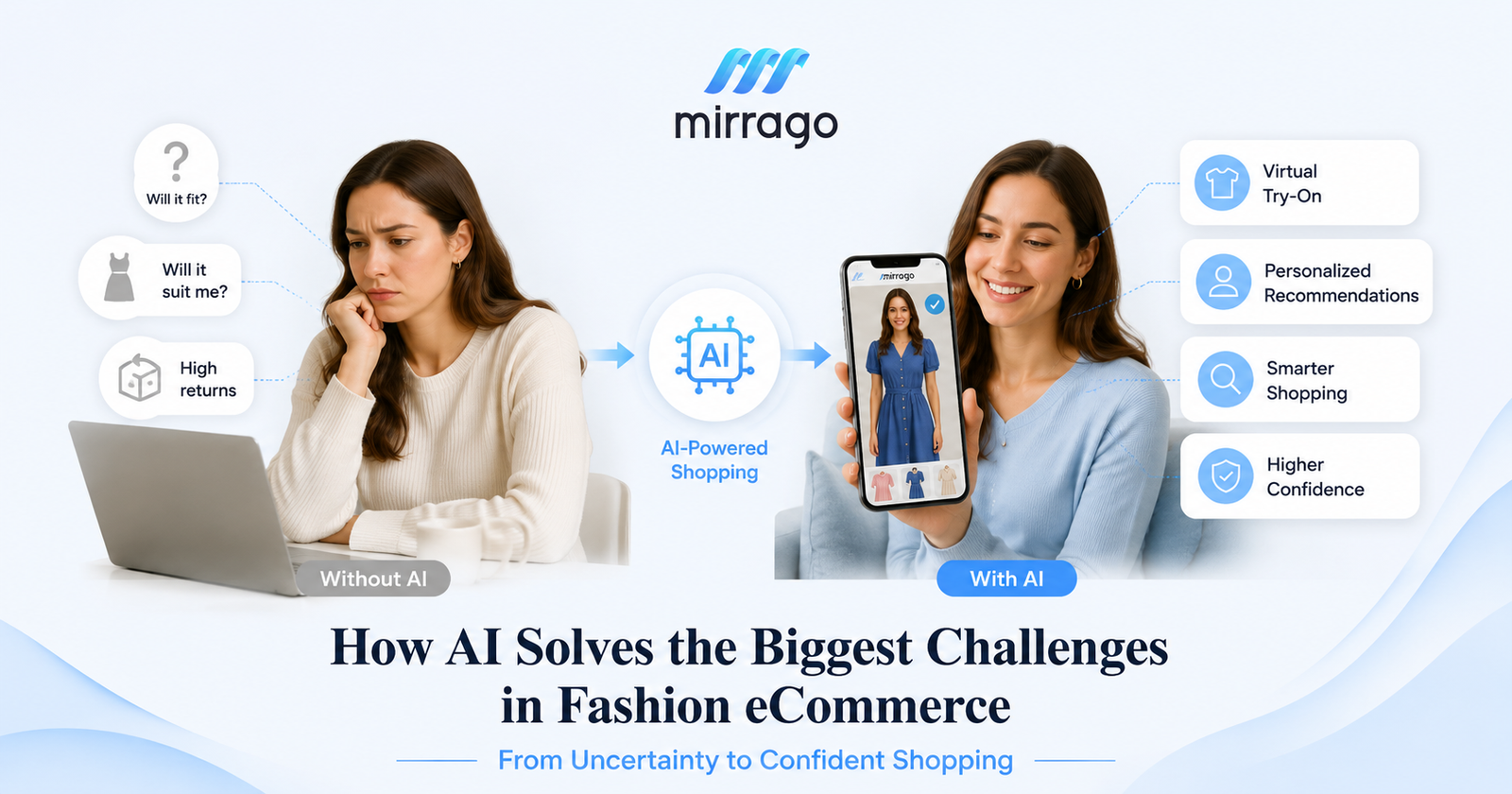
Shopping Before AI vs Shopping With AI
It helps to see the difference side by side. Here is how AI in fashion e-commerce has changed the experience for brands and their customers.
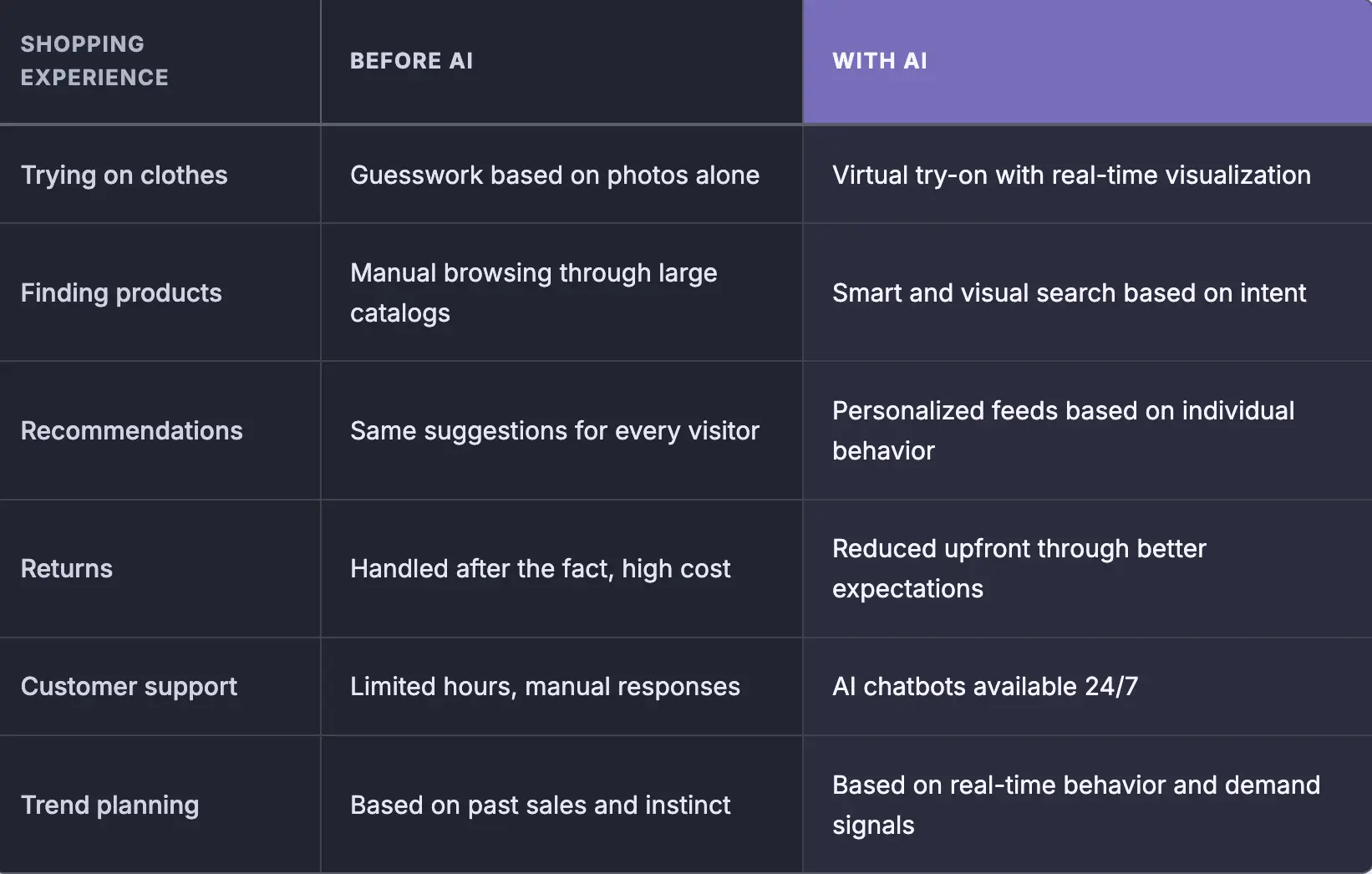
Let's explore the biggest challenges in fashion e-commerce and see how AI in fashion e-commerce is helping solve each one.
1. Customers Can't Imagine How Clothes Will Look
A lot of customers are reluctant to buy something at the checkout just because they can't imagine it on them. What a model looks like in photos is not necessarily what a garment will look like on a different person of a color combination, skin tone, or shape. This is one of the biggest reasons people lose confidence and abandon their carts.
Before AI, it was consumers who were left to guess, read product descriptions, and have a bit of hope. Clothing AI is here to take the guesswork out of the equation in the modern world:
AI virtual try-on that shows how an outfit looks in real time
Virtual AI fitting rooms based on the customer's own photo or avatar
Personalized previews of decisions to buy feel informed instead of risky
2. High Product Return Rates
One of the largest expenses in fashion e-commerce is returns. Products that don't meet the customers' expectations are returned, resulting in additional shipping and restocking costs.
AI can alleviate the returns problem by providing greater confidence to shoppers before they make a purchase.
Better product visualization that sets accurate expectations upfront
Personalized recommendations matched to body type and preferences
More confident purchase decisions that lower return rates over time
3. Finding the Right Products Takes Too Long
In fashion stores, there are thousands of products, which makes it difficult for the customer to find what they want. Having too many options can cause decision fatigue, leading customers to leave without buying anything.
Customers can find the most relevant styles in less time than ever before with AI-powered product discovery by leveraging smarter product recommendations and search.
Recommendations based on what a user has been browsing.
Smart search that understands what users mean, not just the exact keywords they type
Visual search that lets customers search using images
AI outfit suggestions that simplify the whole decision
4. Every Customer Wants Personalized Shopping
Nowadays, shoppers want to have their shopping experience tailored to their style, preferences, and needs. The days of a generic product feed are over; there needs to be something more.
AI creates a customized shopping experience by predicting what items are likely to appeal to individual customers based on their browsing history and preferences.
AI recommendation engines that learn from customer behavior
Personalized product feeds built around each shopper
AI styling suggestions that feel relevant, not random
5. Cart Abandonment Remains High
Many shoppers add products to their shopping cart and then abandon their purchase. Most of the time, they continue to have no idea if the product looks good or not.
The use of AI makes this hesitation a lot less, with the addition of personalization features and virtual try-on experiences for customers.
Virtual try-on that removes last-minute doubt
Personalized offers that encourage completion
Better recommendations that reassure the choice
Shopping confidence built through visual proof
6. Customer Support Is Expensive
As fashion brands grow, so does the volume of customer questions about how they look on them, style, availability, and delivery. Hiring enough support staff to answer everything manually is costly and difficult to scale.
This used to be a waiting period or assistance that was available only during regular business hours. AI doesn't do this the way it used to:
AI chatbots that answer common questions instantly
An AI shopping assistant that guides customers through decisions
Instant product recommendations during conversations
24/7 support that never takes a day off
7. Fashion Trends Change Quickly
Fashion trends change quickly. If brands can't keep up, they may overstock products that don't sell or run out of the ones customers want most. Being accurate in predicting demand is always one of the most difficult things to do in a fashion business.
Forecasting was traditionally based on a great deal of sales and a certain instinct, which frequently did not match the customers' next purchase. Rather, AI reads real-time signals:
Trend forecasting based on live customer data
Customer behavior analysis that reveals shifting preferences
Demand prediction that reduces guesswork
Better inventory planning that saves cost and reduces waste
How Mirrago Helps Fashion Brands Create Better Shopping Experiences
Mirrago integrates all these AI-powered fashion e-commerce features into one system, tailored for fashion brands. Customers no longer have to guess what a product will look like on them before buying, which significantly reduces hesitation and returns. They can "virtually" try on outfits.
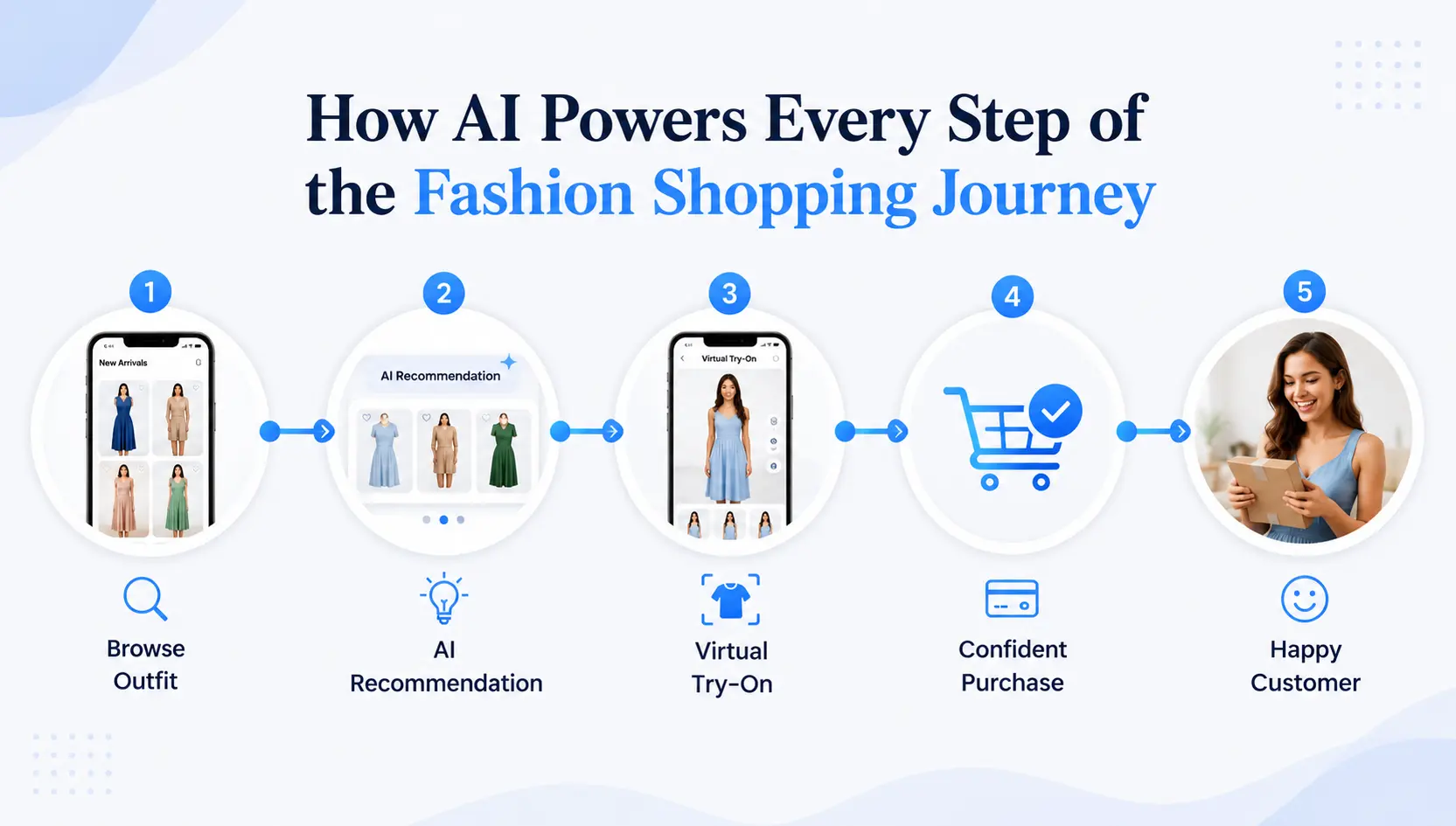
Here's how this works in practice:
Virtual try-on lets customers preview outfits before purchasing them.
Style discovery powered by AI that pops up items shoppers will probably be more interested in.
Recommendations based on a user's preferences, not general best sellers.
No need for brands to rebuild their store, as this integrates easily with existing e-commerce platforms
Smoother path towards purchase with genuine customer confidence
For fashion companies, this means that consumers will be more inclined to make quality purchase decisions, less likely to return items, and more likely to have a personalized shopping experience. This benefits both the customer's shopping experience and the brand's efficiency and profitability.
What these AI Improvements Mean for Fashion Brands
Adopting AI in fashion e-commerce is not just about keeping up with technology. The broader shift toward AI in e-commerce shows the same pattern: it directly impacts the business metrics that matter most
Higher conversion rates from more confident shoppers
Lower return rates thanks to better visualization and shape guidance
Better customer confidence throughout the buying journey
Increased customer satisfaction from personalized experiences
More repeat purchases as trust in the brand grows
Stronger customer loyalty built over time
Smarter business decisions powered by real data
A long-term competitive advantage in a crowded market
These benefits answer a question many fashion brands are asking today: Why invest in AI now?
The answer is simple: brands that remove uncertainty from the shopping experience earn customer trust. When shoppers feel confident in their choices, they're more likely to buy, return less, and come back again.
Conclusion
Fashion has always been about personal style, and online shopping should feel the same way. While fashion brands are grappling with challenges like purchase hesitation, high returns, and cart abandonment, AI is emerging as a transformative force to address these concerns, with its significant impact in personalizing the shopping process and fostering customer confidence.
AI is transforming the experience of shopping for fashion online with features like virtual try-on, advanced product recommendations, enhanced customer support, and trend prediction. Companies that adopt these technologies will have a greater capacity to meet customer expectations, build customer trust, and grow the business amidst the competition.
The future of fashion eCommerce is not just about growing sales; it's about providing customers with shopping experiences that they can trust.
Want to reduce returns and boost conversions with AI?
Explore Mirrago for Business →