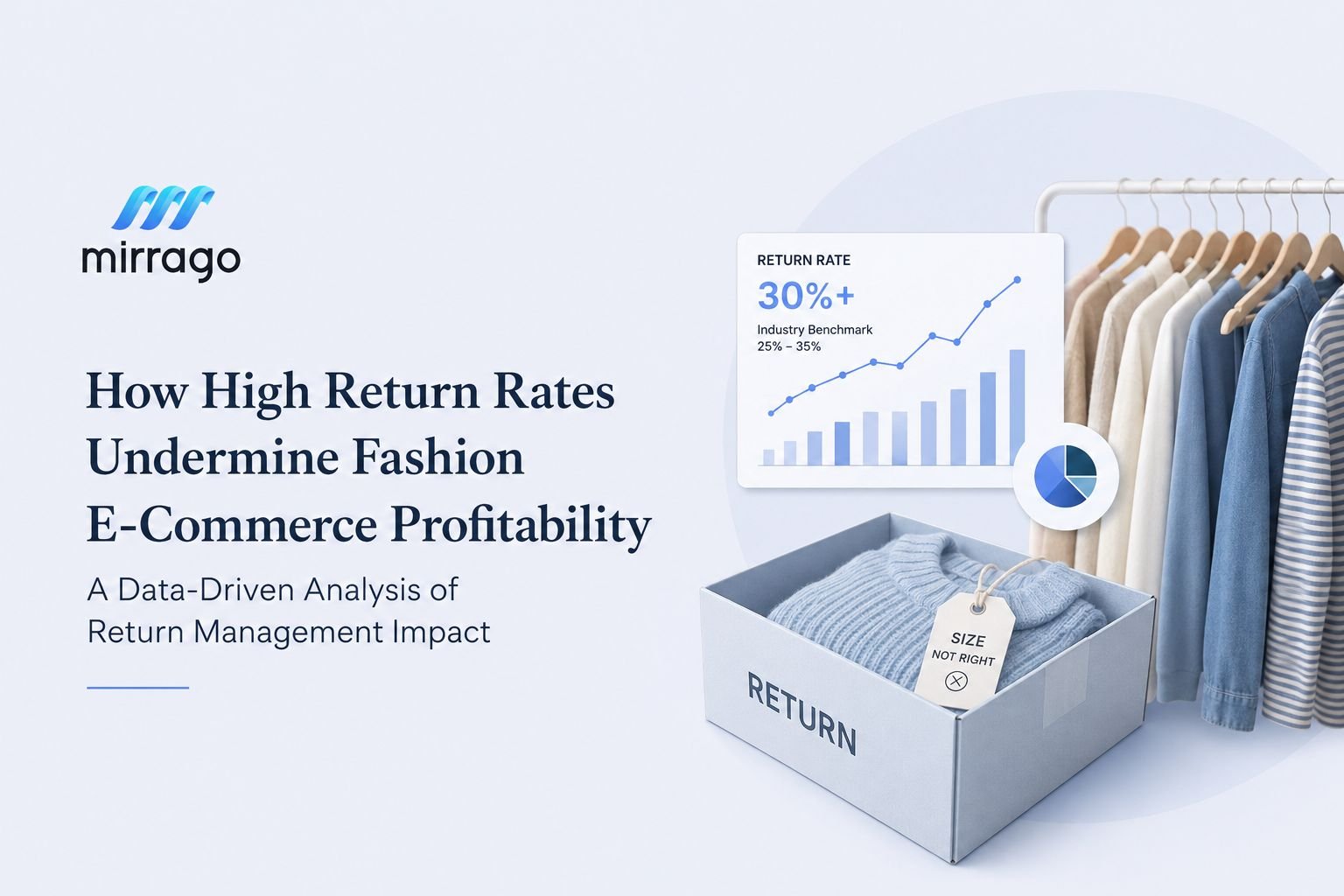
A Data-Driven Analysis of Return Management Impact
Fashion e-commerce brands often celebrate traffic growth and rising GMV, but there is a hidden profitability problem that can quietly erase those gains: high return rates. In mid-to-large-scale online fashion retail, unmanaged returns are no longer just an operational inconvenience; they are a structural threat to margin performance. ASOS FY23 Results Statement
This article examines the month-by-month financial impact of returns and explains why sizing-related returns are the biggest preventable driver of margin leakage. Rethinking Sizing & Returns
Executive Summary
While many brands focus on acquiring more customers and increasing gross merchandise value, high return rates can undo much of that progress. A return-heavy business may look healthy at the top line while quietly losing profitability through refunds, reverse logistics, and markdowns. E-commerce Return Rate Benchmarks
In the example below, a brand with $1 million in monthly gross revenue suffers more than $500,000 in monthly profit impact during a peak return month. That level of leakage directly affects reinvestment capacity, scaling, and long-term profitability. e-commerce Return Rate Benchmarks
The Business Context
ASOS provides a clear example of how serious return management can become at scale. In its public financial disclosures, the company acknowledged that uncontrolled return rates were reducing per-order profitability, while returned inventory built up in the warehouse awaiting inspection, cleaning, and resale. ASOS FY23 Results Statement
ASOS later introduced a “fair use" policy to address unusually high return behavior, especially bracketing, where shoppers buy multiple sizes of the same product and return the ones that do not fit. The policy was part of a broader effort to improve profitability by reducing excessive returns. ASOS Fair Use Policy
The Monthly Financial Impact
To illustrate the financial effect of returns at scale, consider a mid-sized fashion brand with $1 million in monthly gross revenue. Using an industry-standard 30% return rate and $15 in operational costs per returned unit, the cost of returns becomes easy to see. E-commerce Return Rate Benchmarks, Apparel Returns Cost Analysis
Metric | January | February | March (Peak) | April |
Gross Orders Placed | 10,000 | 9,500 | 12,000 | 10,500 |
Average Order Value | $100.00 | $100.00 | $105.00 | $100.00 |
Gross Revenue | $1,000,000 | $950,000 | $1,260,000 | $1,050,000 |
Return Rate (%) | 30.0% | 28.0% | 34.0% | 31.0% |
Returned Units | 3,000 | 2,660 | 4,080 | 3,255 |
Refunded Revenue (Lost Sales) | $300,000 | $266,000 | $428,400 | $325,500 |
Reverse Logistics Cost (@$15/unit) | $45,000 | $39,900 | $61,200 | $48,825 |
Inventory Markdown Loss (10%) | $30,000 | $26,600 | $42,840 | $32,550 |
Total Monthly Impact on Profit | $375,000 | $332,500 | $532,440 | $406,875 |
True Net Revenue | $625,000 | $617,500 | $727,560 | $643,125 |
In the peak month of March, unmanaged returns cost nearly $532,000 in profit impact. That is a 42% reduction in true net revenue compared with gross revenue, which directly limits the brand’s ability to reinvest and grow. E-commerce Return Rate Benchmarks
Why Returns Happen
Industry research consistently shows that sizing and fit issues account for a majority of fashion returns. Multiple current reports place that share at around 65%, making sizing the biggest avoidable root cause in apparel return behavior. Rethinking Sizing & Returns Presize Sizing Report
When size charts are unclear or incomplete, shoppers rationally protect themselves by ordering multiple sizes of the same item. That behavior shifts the trial-room experience from the store to the brand’s warehouse and logistics network. Rethinking Sizing & Returns
What Is Preventable factor
Because sizing problems drive such a large share of returns, a significant part of the monthly profit loss is preventable. In the March example above, more than $340,000 of the total monthly impact could potentially be recovered by improving sizing, communication, and fit guidance. Rethinking Sizing & Returns
This is why size guidance should be treated as a core profit lever rather than a cosmetic customer experience feature. Better fit information reduces return volume, improves conversion confidence, and preserves margin at the same time. Rethinking Sizing & Returns
Strategic Opportunity
If a brand keeps spending on acquisition while reverse logistics continues to drain margin at a 30% return rate, growth becomes less efficient over time. The most effective way to improve returns is not simply to process them faster but to prevent them in the first place. e-commerce Return Rate Benchmarks
That makes sizing intelligence a strategic necessity for fashion e-commerce operations. Brands that solve fit problems reduce friction for customers and protect profitability at the same time. Rethinking Sizing & Returns
Recommended Actions
Short-term: 0-3 months
Audit the accuracy of the current size chart against real customer measurements. Rethinking Sizing & Returns
Identify high-return SKUs and product categories. e-commerce Return Rate Benchmarks
Add size filters and comparison tools at the point of purchase. Rethinking Sizing & Returns
Medium-term: 3-6 months
Deploy interactive fit visualization tools such as 3D fitting, augmented reality, or AI-powered sizing assistants. Rethinking Sizing & Returns
Create detailed product dimension guides with real-world reference points. Rethinking Sizing & Returns
Test customer feedback mechanisms and refine sizing guidance iteratively. Rethinking Sizing & Returns
Long-term: 6+ months
Invest in predictive sizing algorithms based on historical order and return data. Rethinking Sizing & Returns
Integrate sizing intelligence into personalization and recommendation engines. Rethinking Sizing & Returns
Build customer profiles that improve fit prediction over time. Rethinking Sizing & Returns
Conclusion
Return rate management now determines whether fashion e-commerce businesses can maintain healthy per-order profitability. While industry benchmarks suggest return rates in the 25% to 35% range are common, that does not mean they are inevitable. e-commerce Return Rate Benchmarks Fashion Return Benchmarks
Brands that improve sizing clarity and fit communication can reduce returns, recover margin, and build stronger customer relationships. For modern apparel retailers, shifting from reactive reverse-logistics management to proactive fit optimization is both strategically essential and financially transformative. Rethinking Sizing & Returns
Source Notes
ASOS financial and policy references are linked directly in the relevant lines above. ASOS FY23 Results Statement
Return-rate benchmark references are linked directly in the relevant lines above. e-commerce Return Rate Benchmarks
Sizing and fit return references are linked directly in the relevant lines above. Rethinking Sizing & Returns