Your product page is the moment of truth.
A customer has already found your brand, interacted with your content, and clicked into your website. These few moments can make a customer or make them walk out without making a purchase!
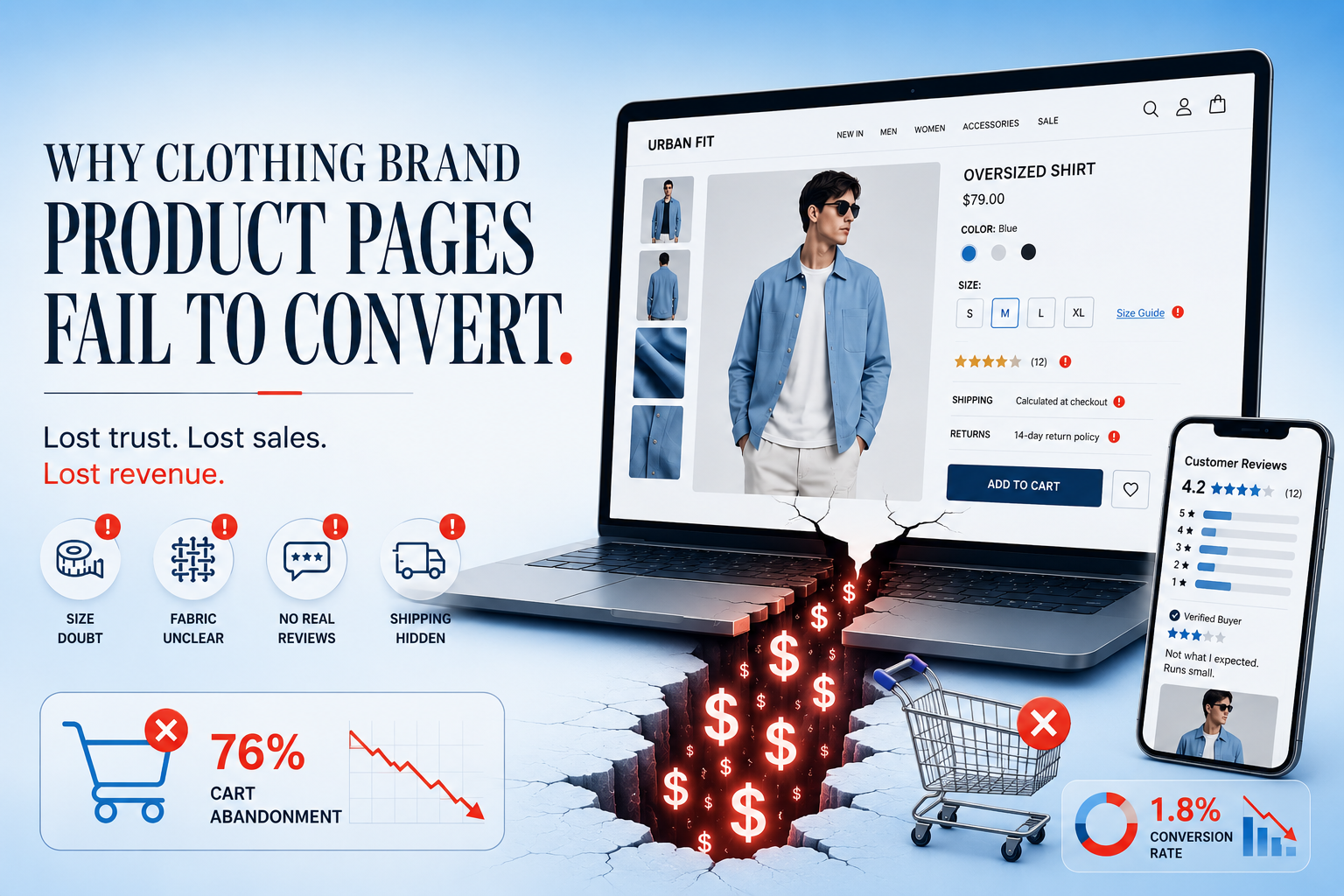
Many clothing brands believe more traffic is the answer. But traffic alone does not generate sales. Fashion e-commerce websites convert just 1.8% of visitors on average, meaning more than 98 out of every 100 people who land on your store leave without buying.
It is not so much a problem with the product itself. It's the purchasing process. If customers aren't sure about sizes or fabrics, return policy, or shipping information, they become hesitant.
In a physical store, a sales associate can answer these questions instantly. Online, your clothing brand product pages have to do that job on their own. When they fail to build trust and remove uncertainty, potential customers leave.
Size Uncertainty Stops Shoppers Before They Even Decide
Sizing is the biggest unresolved question in fashion e-commerce. When a shopper cannot confidently answer, "Will this fit me?" they do not take a risk. They leave.
This is not a new problem. But it remains stubbornly unsolved, and the numbers make clear just how much damage that is doing to clothing brands right now.
70.48% of fashion shoppers abandon their carts, and sizing anxiety is consistently ranked as one of the leading reasons why.
Most brands are still doing what they did a decade ago: a size chart with chest measurements in inches or centimeters. Small: 34". Medium: 36". Large: 38". Technically accurate. Practically useless.
A number on a chart cannot tell a shopper whether a garment will sit loosely on their frame or pull across the shoulders. It cannot tell them whether the waist runs narrow, whether the cut runs long, or whether the fabric has enough stretch to accommodate their body comfortably. All of those decisions happen at the product page, and when the page cannot answer them, the shopper cannot commit.
Here is where it gets more expensive than most brands realize
The shoppers who do not abandon the cart entirely often solve their own uncertainty by purchasing two or three sizes at once, planning to return whatever does not fit. This is called size bracketing, and it is quietly destroying apparel margins across the industry. The product page failure does not just cost the conversion; it creates the conditions for every costly return that follows. We cover that in full detail in Why Online Returns Are Becoming a Big Problem for Fashion Businesses.
The model problem nobody talks about
Product photography adds another layer of confusion. Most fashion brands shoot on a single studio model and provide no body data whatsoever. The shopper sees the garment looking great and has no reference point for themselves. They are left asking:
How tall is the model?
What size is being worn in this photo?
Does this run small, true to size, or oversized?
How would it look on someone built like me?
The shopper is making a completely blind bet. Most are not willing to take it. And the ones who leave are not coming back.
Static Photography Cannot Communicate What Fabric Actually Feels Like
A beautiful design and an attractive price can grab attention. But if shoppers can't judge the fabric, the way it flows, or whether it truly looks as shown online, uncertainty often stops them from buying.
This is a texture deficit and one of the least talked-about conversion killers in online fashion.
Why studio photography is working against you
Professional product photography is designed to make garments look their best. The lighting is perfect. The colour is saturated. The wrinkles are steamed out. The model’s pose is chosen to show the garment at a flattering angle.
The issue is that this kind of “polish” actively discourages what information shoppers really want. The following, which can be seen in a heavily edited studio image, is hidden:
• Fabric texture and surface detail
• Stitching and construction quality
• True colour under natural lighting
• How the garment actually drapes on a body
• Whether the material is structured or relaxed, heavy or lightweight
When the image looks too perfect, shoppers grow suspicious rather than confident. They have been burned before. They ordered something that looked elegant in the photo, but it arrived looking nothing like it. That prior experience does not disappear when they land on your product page. It sits behind every purchase decision they make.
Static images cannot answer the questions that close a sale
Fashion is a tactile, kinetic category. How a garment moves matters as much as how it looks at rest. A static image cannot show the following:
• Whether the fabric flows or holds its shape
• How it stretches during movement
• Whether it wrinkles easily or recovers well
• How it sits on the body when the wearer walks, sits, or turns
There are no fly-on-the-wall moments. They are the key determinants in categories such as activewear, eveningwear, knitwear, and tailoring. If a product page fails to communicate them, the shopper creates one in their mind, and doubt is invariably an all-too-familiar weapon that ultimately ends in a sale.
Flat photography does not create uncertainty. It confirms it. A shopper who cannot see how a garment moves has already been given a reason to hesitate
This is not a photography budget problem. It is a content strategy problem. Brands that convert well know exactly what information a shopper needs to feel confident, and they build their visual content around those needs, not around making products look aspirational in isolation.
Social Proof Exists, But Shoppers Never See It
Customers trust other customers. Not brand copy. Not studio photography. Not carefully crafted product descriptions. Real buyers who purchased the product, wore it in actual life, and formed an honest opinion.
Most clothing brands have collected reviews. Many have received customer photos. Some have built a genuine base of satisfied buyers. However, if such social proof isn't readily apparent at the time, when the shopper is actually considering whether to buy that product, it's like it never existed.
Verified buyer reviews add a 15% lift in conversion, and products with 11–30 reviews convert 68% higher than those with none, yet most clothing brand product pages bury this evidence where shoppers never see it.
The placement problem
Most commonly, it's placing reviews at the end of a very long product page. The customer must go past each page of photos, each description paragraph, each size chart, each cross-sell suggestion, each shipping detail, and finally find the one thing that can convert them.
Few will be reaching this mile. Very few are going to scroll that far. This data has been consistent in all studies; most buyers' actions happen on the first page of content they encounter. Shoppers who are looking for social proof mean the lowest cut; the proof is invisible to them.
The representation gap
There is a second, less-discussed dimension to the social proof problem: who the reviews and photos represent.
When a shopper cannot see the product on someone who resembles them, someone of similar height, similar build, or similar body type, the review loses much of its power. A five-star rating from someone whose body the shopper cannot relate to still leaves the core question unanswered: “But how will it look on me?”
Fashion is one of the most personal product categories in e-commerce. Buying confidence depends heavily on identification. When social proof reflects only one type of body, it serves only one type of shopper. Everyone else remains unconvinced.
The absence of social proof does not just reduce trust. It creates an active signal that something may be wrong. Shoppers notice when they cannot find evidence that other people have bought and been satisfied. That silence reads as a red flag.
Why Hidden Checkout Fees Make Customers Leave
A shopper who has spent several minutes on a product page has already invested time and emotional energy in the decision. They have considered the size. They have looked at the images. They have read the reviews. They are close to buying.
Then they reach checkout and discover a shipping fee they were not expecting. Or a delivery window that is significantly longer than assumed. Or a returns policy that is difficult to find, vaguely worded, or more restrictive than they were led to believe.
At that point, the trust the product page worked to build collapses in seconds. The shopper abandons the cart. The sale is gone.
76.48% of fashion shoppers abandon their cart, and 48% cite unexpected costs at checkout as the primary reason.
How Unclear Pricing Affects Customer Trust
When a product page withholds information about shipping costs, delivery timelines, or returns policy, shoppers do not simply notice the gap. They interpret it. And the interpretation is rarely generous.
A shopper who cannot find shipping information before checkout assumes the worst. A shopper who cannot easily locate a returns policy assumes the brand is hiding something unfavorable. Both assumptions reduce buying confidence at the exact moment confidence needs to be highest.
This is not a checkout problem. It is a product page problem. The information shoppers need to commit to a purchase, what the final price will be, when it will arrive, and what happens if it does not work out belongs on the product page, not buried in a footer link or revealed at the final checkout step.
Transparency is not a concession. It is a conversion strategy. Shoppers who know exactly what they are committing to before reaching checkout are far more likely to complete the purchase.
A Slow or Broken Mobile Experience Kills Conversions Where Most Shopping Happens
Most fashion shoppers are not sitting at a desktop when they discover and consider your products. They are on a phone, often while doing something else, commuting, watching television, or taking a break. Their attention is already divided. Their tolerance for friction is low.
When a product page is slow to load, sluggish to respond, or difficult to navigate on a small screen, that fragile window of purchase intent closes almost immediately.
The mobile experience most brands are actually delivering
Many clothing brands design primarily for desktop and treat mobile as an afterthought or assume that a responsive layout solves the problem. It does not. A layout that reflows for mobile is not the same as an experience designed for mobile behavior.
Common mobile failures on fashion product pages include:
Images that take several seconds to load on standard mobile connections, causing a bounce before the product is even seen
Size and colour selectors that freeze or lag when tapped, breaking the browsing momentum that leads to purchase
Touch targets that are too small, causing mis-taps and frustration
Product videos that do not autoplay or buffer continuously on mobile
Pages where the Add to Cart button requires excessive scrolling to reach
Google’s Interaction to Next Paint (INP) metric, now a Core Web Vitals, measures exactly how quickly a page responds to user actions. Poor INP scores on fashion product pages correlate directly with elevated bounce rates and lower conversion. This is not a technical metric for developers. It is a revenue metric for brand owners.
Why This Problem Is Becoming More Expensive to Ignore
Fashion e-commerce advertising is largely a mobile-first channel. Paid social media campaigns on Meta and TikTok deliver the vast majority of their clicks to mobile devices. When a brand pays for a click from a mobile user and that user encounters a slow, frustrating product page, the ad spend is wasted. Not partially wasted. Completely wasted.
The Digital Applied benchmarks for 2026 note that bounce rates on paid ad traffic spike to 65% or higher when the landing experience does not match the speed and fluidity shoppers expect from their phones. That means more than six in every ten paid clicks are generating zero return on a slow or poorly optimized product page.
Scaling ad spend to a mobile product experience that converts poorly is not growth. It is an accelerated version of the same loss. More traffic, same broken page, bigger budget wasted.
Product Page Failure Fits in the Bigger Picture in a Fashion Brand
Product page conversion is one of five structural problems causing clothing brands to lose online sales in the digital era. Understanding this failure in isolation is useful. Understanding how it connects to the others is essential.
The sizing uncertainty that drives unconverted visitors is the same sizing uncertainty that drives return rates. A shopper who cannot determine their size on the product page either abandons the cart or purchases speculatively and returns the items that do not fit. Both outcomes damage the business. The product page failure triggers both.
Similarly, the trust deficit created by weak social proof on the product page is the same trust deficit that drives cart abandonment at checkout. The shopper who could not find confident evidence from other buyers on the product page is the same shopper who hesitates at the size dropdown and closes the tab.
These problems are not parallel. They are sequential. Each one sets up the next. The product page is where most of the damage originates, because it is the first environment in which the shopper asks whether this purchase is a safe decision.
Conclusion
While it's essential to attract visitors to your website, traffic does not mean sales. Sometimes the distinction between the browser and the buyer is contingent on the way your product page answers customer questions.
If people aren't sure whether some clothes are the right size, the right fabric, have good reviews, ship quickly, or take returns, they're naturally going to hesitate. In fashion e-commerce, doubts can be the final hurdle in the path of a sale, even if they are small.
That's why high-performing product pages in the clothing brand are important to have high conversions, which don't just rely on fancy product photos. They are built to foster trust, give clarity, and eradicate friction from the sales process. With customer confidence, this can lead to greater conversions, lower returns, and ultimately, first-time visitors who become loyal customers.
Still losing buyers to sizing doubts and product page friction? Mirrago's AI-powered virtual try-on helps clothing brands turn hesitant browsers into confident buyers directly on the product page. See how Mirrago works