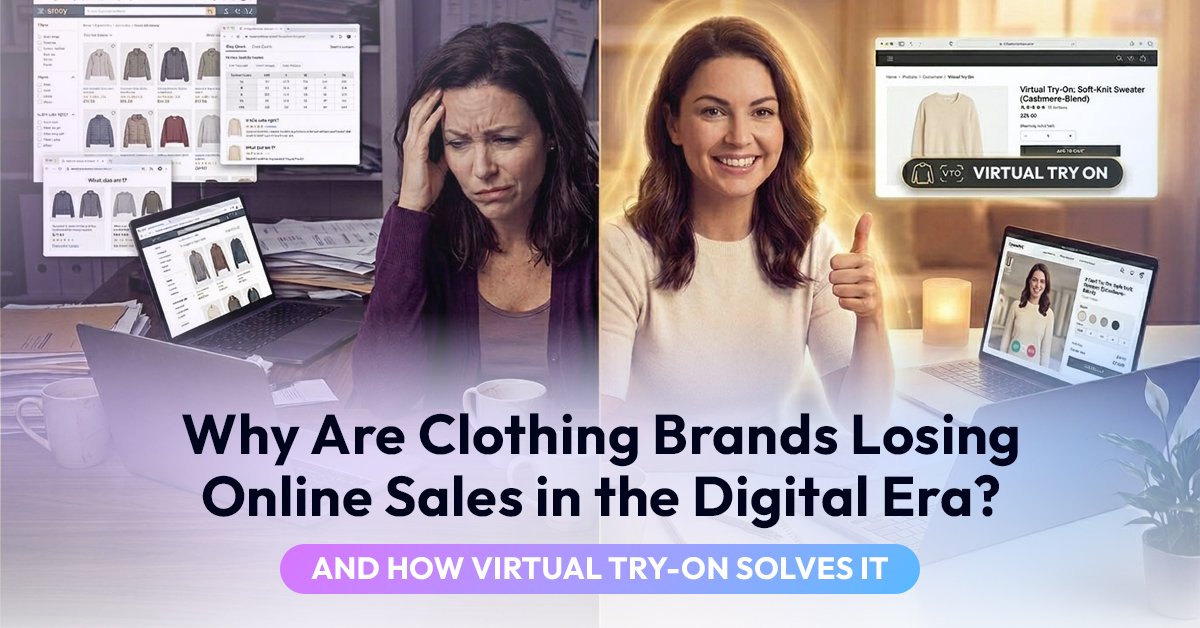
Many people are shopping online for clothes more than ever before. But here is the strange part: many fashion stores sell less, not more.
It's not just that a whole generation of shoppers is spending hours browsing Instagram feeds, but that they're also scrolling through product pages and saving items to their Wishlist. However, once it's time to click "Buy Now", they're gone.
This is the actual reason why clothing brands are losing online sales, and it's not because of poor design or poor-quality clothes. There are 5 specific issue areas in your store where customers lose trust and leave.
To solve the problem, we first need to understand where it's happening and why.?
The Real Problem: Where Fashion Stores Lose Sales
When shoppers land on a product page, their mindset changes.
They stop thinking "I love this" and start asking questions: Will it fit me? Is the fabric of good quality? What if I need to return it?
This shift from excitement to uncertainty is where many fashion brands lose potential customers. The good news is that these doubts usually appear at a few predictable points in the buying journey, and each one can be addressed.
1. High Return Rates Are Quietly Bleeding Revenue
Most store owners look at their sales numbers and feel relieved. What they do not see is how much of that revenue quietly disappears after returns are processed.
The fact that shoppers are unable to try clothes before buying means that many of them employ an easy solution. They buy the same item in two or three sizes, Small, Medium, and Large, and are aware that if it's not small enough, it will be returned. This is known as size bracketing, and it is very prevalent in online fashion.
The result? Your revenue looks healthy for a week or two. Then the returns come in, and the real cost hits.
How this problem damages your business:
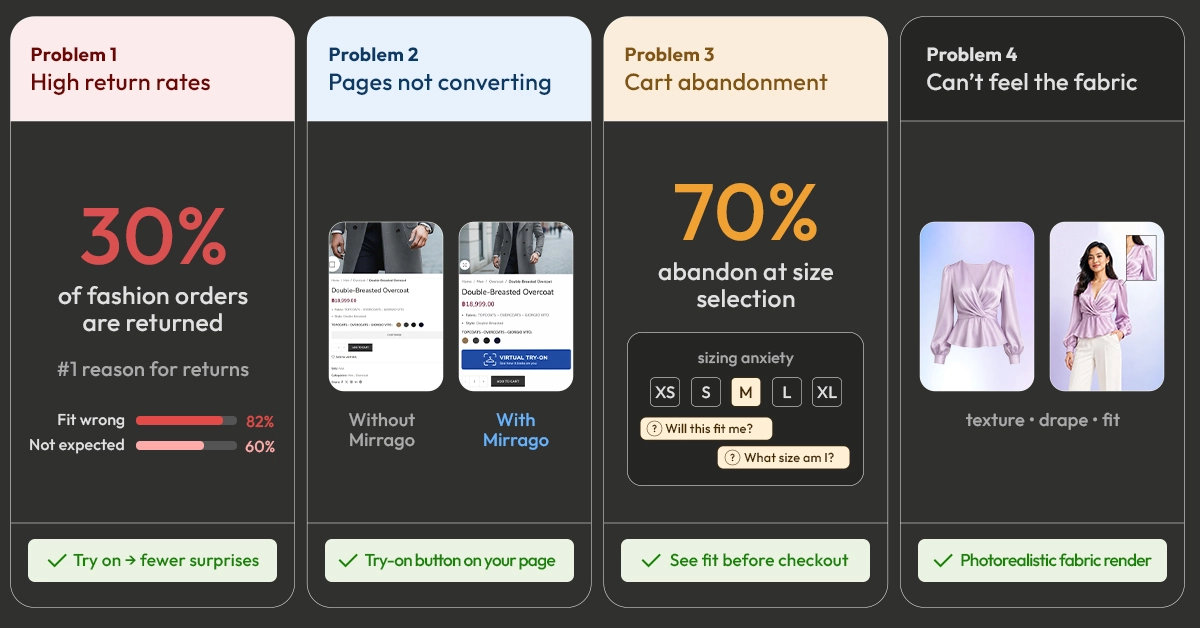
According to Pitney Bowes, processing a return swallows an average of 21% of the total order value, which silently eats up to 30% of your gross profit. In fact, logistics audits by Cahoot.ai show that reverse shipping, restocking labor, and inventory depreciation can instantly consume up to 65% of an item’s original retail value.
According to Pitney Bowes BOXpoll research, the average cost of processing a single return is approximately $20.75, with total operational overhead for apparel brands typically ranging between $15 and $30 per package once shipping, labor, and restocking are factored in.
At that rate, reverse logistics expenses can silently eat up to 30% of your gross profit on affected orders. This financial drag is backed by data from Pitney Bowes, which proves that returns consume an average of 21% of the total order value, directly cannibalizing apparel margins.
While returned items are in transit, your stock is frozen, meaning you miss the peak selling window for that product
2. Your Product Pages Aren't Converting Browsers into Buyers
Most clothes websites still have the same type of photos from ten years ago: Flat lay images on white backgrounds, ghost mannequins, or one studio photo of a gorgeous model that hardly looks like most of your customers.
But these are not photos of actual consumers that would be helpful for them. What is the motion of the cloth? How does it impact actual bodies? What does it look like from the side or back?
If the answers to those questions aren't provided, the people in the shop leave. Not to a competitor who isn't close by, that you've wasted your ad budget on.
How does this damage your business:
According to Contentsquare, the baseline fashion bounce rate is around 42%, but Digital Applied warns it spikes 65% or higher on paid ad traffic. Flat, static imagery is a primary cause, without seeing how a garment moves or hangs; mobile shoppers quickly lose interest and exit within seconds.
Shoppers decide within 30 seconds whether to stay or leave. Static photos rarely give them enough to stay
Single-angle photography hides drape, texture, and movement, the three things shoppers rely on to feel confident about a purchase
Every bounce from a paid ad visit raises your Customer Acquisition Cost with zero return
3. Cart Abandonment Is Often Just Sizing Anxiety
Cart abandonment occurs at the end of your funnel when the customer has already discovered your store, liked your product, and placed it in an abandoned cart.
They arrive at the checkout screen and freeze when they see the size drop-down.
What if I get the wrong size? That single unanswered question will put the deal to death.
They aren't shopping at another business that competes with them. They have simply shut the table.
How does this damage your business:
According to SellersCommerce, the fashion cart abandonment rate sits at exactly 76.48%. This means nearly 8 out of 10 shoppers who add clothes to their cart to walk away without buying massive conversion drops largely driven by checkout hesitation and sudden sizing anxiety.
Sizing uncertainty is consistently the top reason shoppers abandon fashion carts, ranked above price and shipping fees
These are your warmest potential customers, people who already wanted to buy, and you are losing them at the last step
Retargeting abandoned carts with ads is expensive; fixing the confidence gap at the product page level is far cheaper
4. Weak Trust and Social Proof Stop Shoppers from Buying
A good website creates interest. It doesn't create trust.
Trust is derived from other real people, real customers who purchased your product, wore it in real life, and gave their honest feedback.
A first-time visitor visits your store and only sees your photos taken in a studio and descriptions written and posted by your brand. What goes through their minds? "But does this look good on a real person?"
If they don't get a real answer to that question, many consumers refrain from purchasing.
How does this damage your business:
According to WearView, displaying verified reviews and real-life buyer photos drives a 15% to 30% conversion lift. Data from Landbase highlights that these peer photos act as immediate social proof, answering sizing questions right on the page and removing final buyer hesitation.
When shoppers of diverse body types cannot see the product on someone who looks like them, their confidence collapses. This is both a trust problem and a representation gap
In clothing, quality is subjective; fabric feel, fit, and finish cannot be objectively measured, so shoppers lean heavily on other buyers to validate their decision
Competitors actively building review collections and user-generated content will consistently outperform you on equivalent products
5. Will It Look Good on Me? The Lack of Virtual Try-On is Killing E-Commerce ROI
Online shoppers can't touch or feel products before buying.
No shopper can tell if a fabric is soft or stiff, light or heavy, or stretchy or rigid. They are unable to run a finger down the seam or push the material to determine the thickness. But when they can't feel it, they shield themselves by believing the worst.
This is likely to seem like a low-cost deal. If it's wrong, even though it's entirely incorrect, that's enough to kill off sales or make them think about discounting the amount to take the chance.
How does this damage your business:
When shoppers cannot verify fabric quality, they automatically lower their perceived value of the product, even premium items get mentally marked down
Brands without good texture communication are forced to compete on price, triggering constant discount campaigns that destroy margins
High-end clothing is the most affected. The more expensive the product, the more sensory confidence the shopper needs to make their purchase.
Without close-up fabric videos, texture photography, or material descriptions that translate real-world feel into words, the quality gap between price and buyer trust widens every season
Why Traditional Product Photos and Size Charts Are Failing Stores
Here is the truth: the tools most fashion brands rely on to build buyer confidence simply do not work anymore.
For years, the standard approach was straightforward: taking professional photos of an idealized model, publishing a measurement grid showing inches and centimeters, and letting the shopper figure out the rest.
People no longer spend a lot of time shopping on desktop computers. Nowadays, most shoppers browse on their phones while watching TV, commuting, or taking a break, and they expect a faster, easier experience.
The average mobile shopper does not have a tape measure nearby. They are not going to pause, measure their hips, convert to centimeters, cross-reference a chart, and then decide to buy. That is too much work, and they will simply move on.
The model problem is equally damaging. When a global audience of people of every height, body shape, and build is shown clothing exclusively on one type of studio body, most of them cannot picture how it will look on them. Their confidence does not just stall. It disappears.
Size charts are not a safety net anymore. For many shoppers, they are the reason the sale falls apart.
How Sizing Uncertainty Creates a Cycle of Lost Sales
This is not just about one lost sale. Sizing uncertainty creates a chain reaction that gets worse over time.
Here is how the loop works:
Step 1: Doubt appears on your product page.
The shopper cannot confirm fitness, so they hesitate.
Step 2: They either leave or take a gamble.
Most abandon their cart (76.48%). Those who do buy often order multiple sizes to protect themselves.
Step 3: The returns arrive.
Multiple sizes come back. Your logistics costs a spike. Your stock froze in transit for days or weeks.
Step 4: The margin damage sets in.
Each returned box costs $15 to $30 to process. Multiply that by hundreds of returns per month.
Step 5:
You lose the customer permanently. Industry data shows that over 60% of shoppers who have a bad return experience never buy from that brand again. Not just once, gone for good.
The cycle then repeats with new visitors who face the same unresolved uncertainty.
The only way to break this loop is to fix the confidence gap at the source on your product pages, before the doubt ever forms.
Why Spending More on Ads Won't Fix a Broken Store
When sales slow down, the instinct for most brand owners is to increase their ad budget. More spending on Meta. More Google Shopping. More TikTok content. The logic makes sense on the surface: more traffic should mean more sales.
Here's where many brands get trapped. A 2% conversion rate means 10,000 visitors produce 200 sales. Spend twice as much on ads and attract 20,000 visitors, and you'll get roughly 400 sales, but only because you paid twice the traffic. Your top-line revenue rises, but your Customer Acquisition Cost rises with it, leaving the underlying efficiency problem unsolved.
Now add the return rate to the top of that. You are paying to acquire customers who will return 25% to 40% of their orders. You are paying per click, per return box, and per lost customer.
Scaling ad spend on a store that leaks is not growth. It is an expensive acceleration of the same problem
The correct order is simple: fix your conversion first, then scale your traffic. A store that converts 4% with the same 10,000 visitors generates double the revenue of a 2% store with zero additional ad spend.
Before putting another dollar into paid media, audit the five friction points above. Paid traffic does not repair broken confidence. It just brings more people to a store that cannot keep them.
External Factors Affecting Fashion E-commerce Performance
Internal improvements matter most, but fashion brands also operate in a tough external environment. These factors are making it harder for every online clothing store to convert, and understanding them helps with accurate diagnosis.
Shoppers Are Not Always Digitally Ready.
The majority of consumers have no hesitation in social media, but they are still not sure how to go about online shopping for clothing. They cannot convert body size to size and heavily depend on brands to make it easier for them. When they don't do it, your store is not the one they leave.
Payment and Security Concerns Are Real.
As many shoppers walk away from the checkout when the payment page isn't feeling safe, it's a problem that's growing in size. A lack of familiarity with payment methods, the absence of security badges, and slow checkout on mobile devices can lead to financial anxiety and result in a lost sale.
Too Many Brands, Too Much Noise.
It's easier than ever to launch a clothing online business, because it's more difficult to differentiate than ever. High-quality brands now must do a lot more work to make themselves stand out, and adequately, brands must clearly communicate their value and quality to justify premium pricing, especially when dozens of cheaper alternatives are only a click away.
Fast-Fashion Copycats Are Everywhere.
Large ultra-fast-fashion platforms can clone an independent design and have it listed at a fraction of the price within days of a launch. This drives up ad costs for everyone and creates a race-to-the-bottom pricing environment that crushes independent brand margins.
Online Scams Have Made Shoppers More Suspicious.
Not only have fakes flooded the web with stolen brand photos, but they have even been found on social media platforms like Instagram and Twitter. People have been duped in the past and are now very skeptical of new brands. Yet if your store fails to allude to trust in the reviews you see on your website, easy-to-find contact details, your professional checkout, and well-known payment options, you are likely to lose sales before your product has a chance at a fair shot.
Conclusion
The fashion ecommerce crisis isn't about creativity. It's not that brands are doing it wrong or that their audience is getting older. Operating models that reinforce the image of a flat product, abstract sizing grids, and studio-only models are not aligned with the way people make purchase decisions today, leading to lost sales.
Each percentage drop in your bounce rate, each abandoned cart, and each returned parcel is a measurable result of the same cause - lack of trust at decision time.
The brands that are going to be successful in the next wave of digital retailing may not be the ones with the biggest advertising spend or the most creative advertising. It's those who've instilled in their product pages enough trust, clarity, and fit confidence that the purchase becomes easy.
Fix the five friction points first. Then scale.
Want to Fix Your Sales Drop?
Stop letting sizing anxiety and fabric uncertainty erode your margins with one abandoned cart at a time.
If you are ready to repair your store's conversion leaks, reduce your return overhead, and build the kind of buyer confidence that turns browsers into loyal repeat customers, our optimization solutions are built for exactly this.