e-commerceYour Next Sales Assistant Might Be a Virtual AI Try-On
You find a dress you like. The color is right, the price is fair, and the reviews look good. Then the hesitation creeps in. Will it actually suit you? Will it fit the way it does on the model in the photo? You close the tab and move on, still unsure.
This happens more often than many e-commerce brands realize. A product photo can show the fabric, color, and cut, but it cannot always show what the product might look like on a particular person. A lot of sales slip away when they get to that point between "I like this" and "I'm confident enough to buy this.
In a physical store, a sales assistant fills that gap. They hand you the right size, offer an honest opinion, and help you picture yourself wearing a piece before you commit. Online stores don't have that same interaction. That is where AI virtual try-on can play a similar role online. Instead of asking shoppers to imagine how a product might look on them, it gives them a way to see it for themselves
This article looks at why customers hesitate to buy online, how virtual try-on can work like a digital sales assistant, what it means for fashion brands, and what to consider when choosing a solution for your store.
Why Online Shoppers Still Need Help Before Buying
E-commerce has solved many parts of the shopping process. Customers can browse products, pay instantly, and get their orders delivered to their doorstep. However, today's consumers cannot try on what they intend to purchase, and the following questions linger in their minds.
Will this look good on me?
Will this style actually suit my body shape or skin tone?
How will this fit compared to how it looks on the model?
Some of these questions can be answered with product photos, but not all. A model wears the product, not the customer. The problem isn't always a lack of product information. Sometimes the customer already has enough information but still can't picture themselves wearing the product. Sometimes the customer has enough information but still can't picture themselves wearing the product.
Online shoppers don't just need more product information. They need confidence. What helps is something that lets them actually see themselves in the product, not just read another description of it.
How AI Virtual Try-On Works Like a Sales Assistant
A customer takes a picture of herself, and a product is rendered in her picture instead of a generic model. That small change can make the shopping experience more useful in several ways:
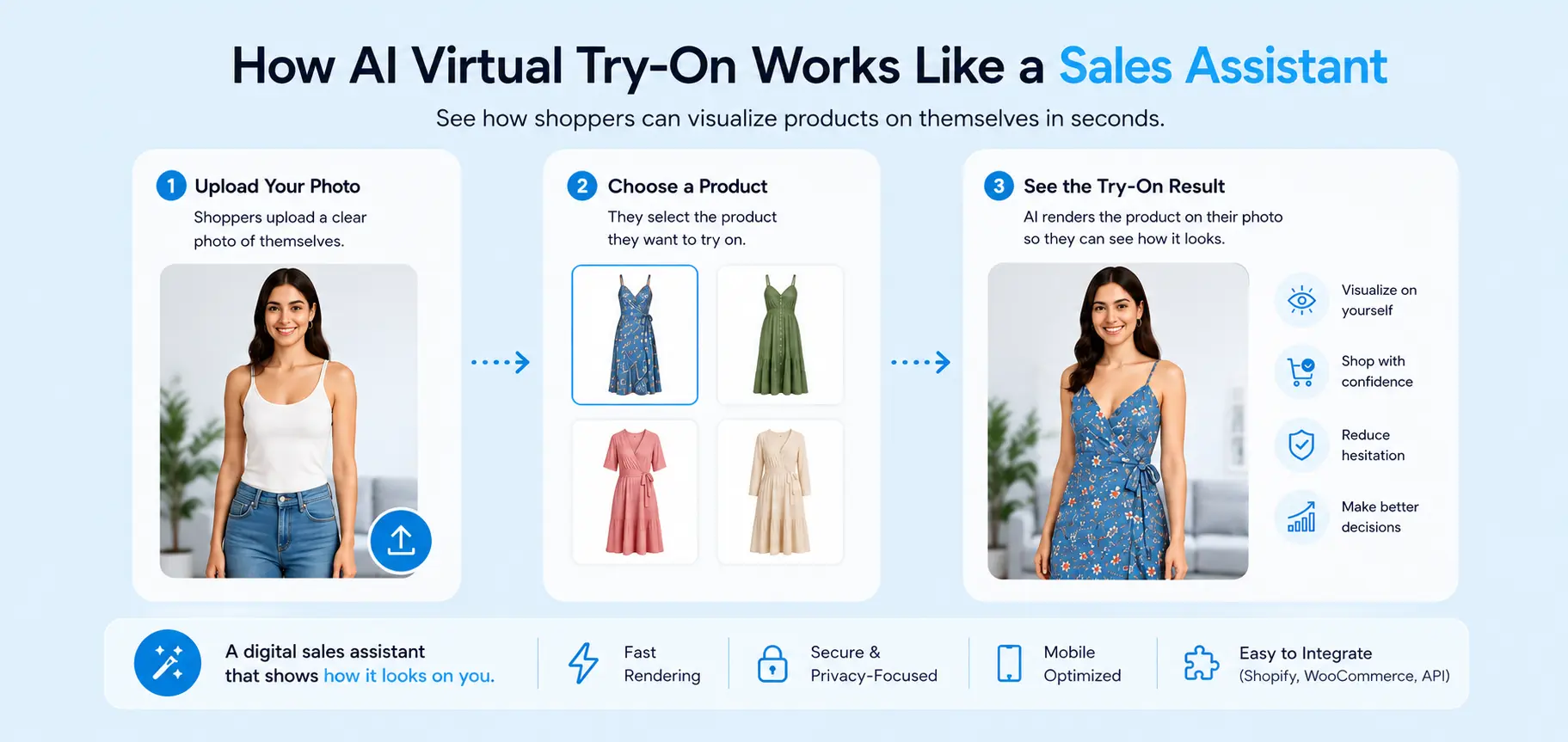
Displays the product on the shopper's body, not a stranger's.
It helps customers visualize an item before adding it to the cart.
It turns product discovery into an interactive experience.
It answers visual questions standard product photos can't.
A traditional sales assistant helps customers understand a product and decide whether it is right for them. Virtual try-on plays a different role: it helps answer the visual question, “How might this look on me?”
From "I Like It" to "I'll Buy It"
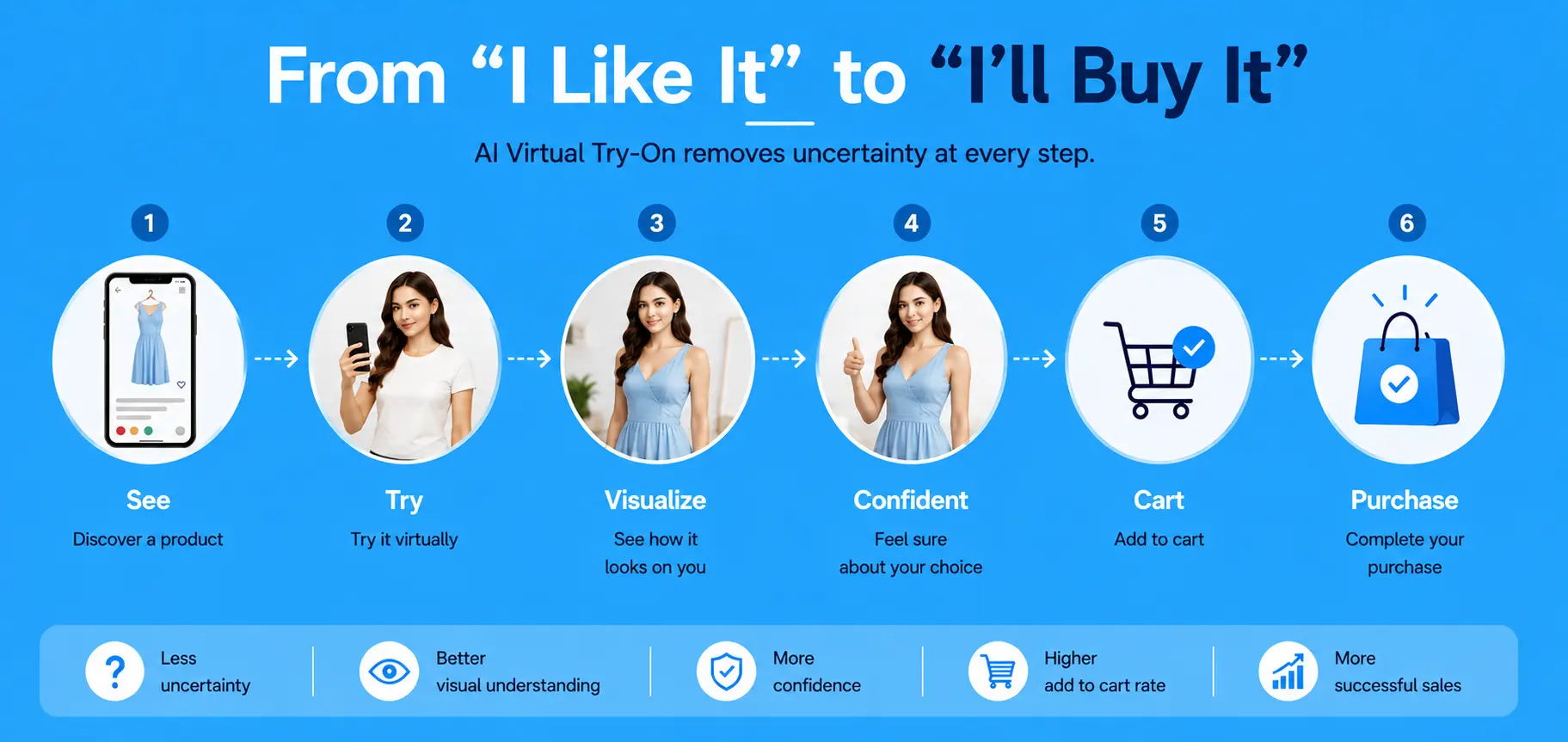
This is where the real shift happens: the path a shopper takes from noticing a product to actually purchasing it.
See the product while browsing a category page or clicking in from an ad.
Try it virtually instead of imagining how it might look.
Visualize the look, fit, color, and style in a way that feels personal.
Feel more confident as the usual hesitation starts to fade.
Add to cart, since visual doubt no longer stands in the way.
Purchase and check out with a clearer sense of what they're getting.
Every stage depends on reducing uncertainty. The technology doesn't try to convince anyone to buy something they don't want. It simply removes one of the biggest reasons people hold back on things they already like.
How AI Virtual Try-On Helps Fashion Brands
Beyond the shopper's experience, AI virtual try-on has clear implications for how fashion e-commerce brands operate.
Reduce purchase hesitation:
Giving customers another way to evaluate a product addresses doubt directly instead of hoping it resolves on its own.
Create a more engaging product experience:
A page with only fixed images is passive. A try-on option turns it into something shoppers actively interact with.
Encourage product exploration:
When trying something on takes seconds, shoppers are more willing to experiment with different colors and styles.
Support confident purchase decisions:
Visual information that traditional photography can't provide, like how a garment sits on a specific body type, gets closer to a real fitting room.
Take some of the experience of the store to the web:
It won't be a replacement for visiting a store, but it certainly does a bit of the job.
Care was needed when making general statements about conversion lifts or return reductions; these would vary from brand to brand and audience to audience, so their veracity must be verified with brand-specific data to give confidence.
What to Look for in Virtual Try-On Software
Not all virtual try-on tools are built the same. A few things are worth checking before you commit to one.
Realistic, natural-looking output
Sharp image quality
Support for different body types
Coverage across clothing categories, from dresses to footwear
Fast rendering, so shoppers don't lose interest
A solid mobile experience, since most traffic happens on phones
Clear privacy practices for uploaded photos
Shopify or WooCommerce compatibility
API or plugin availability
Straightforward implementation that doesn't take months
Platforms like Mirrago are built around several of these criteria, worth keeping in mind as you evaluate options.
Can Virtual Try-On Replace a Human Sales Assistant?
Short answer: No
This technology is genuinely useful for the visualization part of shopping, but it isn't a full replacement for human guidance. Shoppers still rely on things it can't fully provide, including:
Size guides for specific brands and cuts
Detailed product specifications
Customer reviews and real-world feedback
Direct support for questions or issues
Personalized recommendations from a knowledgeable person
Return and exchange information
Think of it as one part of a larger experience. It handles the "what would this look like on me" question particularly well. Everything else, from fit advice to after-sale support, still benefits from human involvement.
A Real Example of the Experience
Picture a shopper browsing for a summer dress. They find a floral dress on the category page and open the product page. Instead of relying only on the model's photos, they upload a photo of themselves to see how the dress might look on them.
They can see the pattern, color, and overall look on their own image instead of trying to imagine it from a model's photo. This gives them a clearer idea of the product and removes some of the guesswork from the buying decision.
They may still check the size guide, reviews, and product details before buying. But now they have one more thing to help them decide: a visual answer to the question, “How will this look on me?”
The Future of AI-Powered Shopping
This capability is unlikely to stay a standalone feature for long. It's already starting to work alongside other AI-driven tools in e-commerce: AI shopping assistants that answer questions in real time, personalized recommendations, AI styling suggestions for full outfits, and conversational commerce, where shoppers chat their way through a purchase.
The future sales assistant may not just answer questions about a product. It may help shoppers visualize, compare, and choose between options in real time, much like a good in-store assistant already does today.
How Mirrago Brings Virtual Try-On to Ecommerce
This is where Mirrago comes in. Mirrago helps fashion brands bring AI virtual try-on into their ecommerce experience, allowing shoppers to see how products might look on them using their own photos instead of relying only on model images.
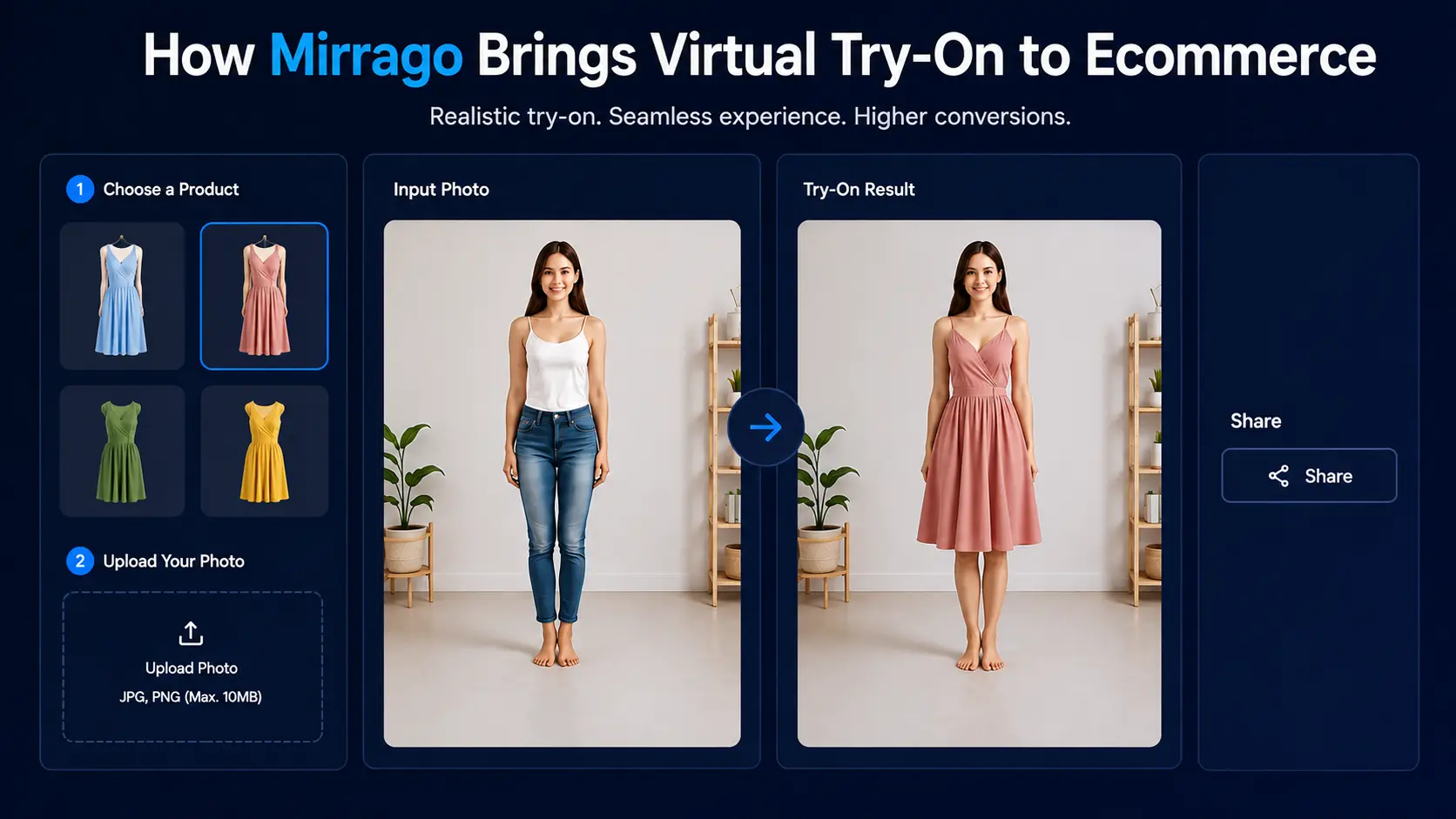
The experience adds a more personal layer to online shopping. Customers can explore clothing and accessories virtually, helping them get a better idea of how a product could look before making a purchase.
Mirrago is designed to fit into existing ecommerce workflows, with options for popular ecommerce platforms and API access for teams that need more flexibility. It does not replace product pages, size guides, reviews, or customer support. Instead, it adds something those elements cannot fully provide: a visual way for shoppers to see the product on themselves.
If you're looking for a way to make your online shopping experience more personal and reduce purchase hesitation, try Mirrago for free and see how virtual try-on could work in your online store.
Conclusion
Shoppers do not always need more information to make a purchase. Sometimes, they simply need to see themselves in the product they are already considering. That is where AI virtual try-on can make a real difference.
A product photo can show the design, color, and details, but it cannot always answer the question, “How will this look on me?” Virtual try-on helps bridge that gap by giving shoppers a more personal way to explore products before they buy.
It does not replace size guides, reviews, or customer support. Instead, it adds another layer of confidence to the buying journey by making the online shopping experience feel a little more like trying something on in a real store.
As ecommerce becomes more personalized, virtual try-on could become a natural part of how people shop online. If you want to see how it can work for your store, try Mirrago for free and give your customers a more visual way to make their next purchase decision.
Ready to see how AI virtual try-on could work for your store?
Get Started For Free →
1. What is AI virtual try-on?
AI virtual try-on is technology that lets online shoppers see how a clothing item, accessory, or pair of shoes would look on their own body, using a photo instead of a generic model. It renders the product onto the shopper's image in real time, helping them visualize fit and style before buying.
3. Does AI virtual try-on improve online shopping conversion?
It can help by reducing the uncertainty that causes cart abandonment, since shoppers get a clearer sense of fit and style before purchasing. Actual conversion impact varies by brand, catalog, and audience, so it's best measured with your own store's data rather than assumed from general claims.
3. How accurate is AI virtual try-on for different body types?
This is where the technology proves its worth or falls short. A tool that only renders well on one body type isn't solving the real problem; it's just recreating the same bias as traditional model photography. Brands should demand consistent, natural results across real customer photos, because that inclusivity is often what separates a feature shoppers trust from one they quietly ignore.