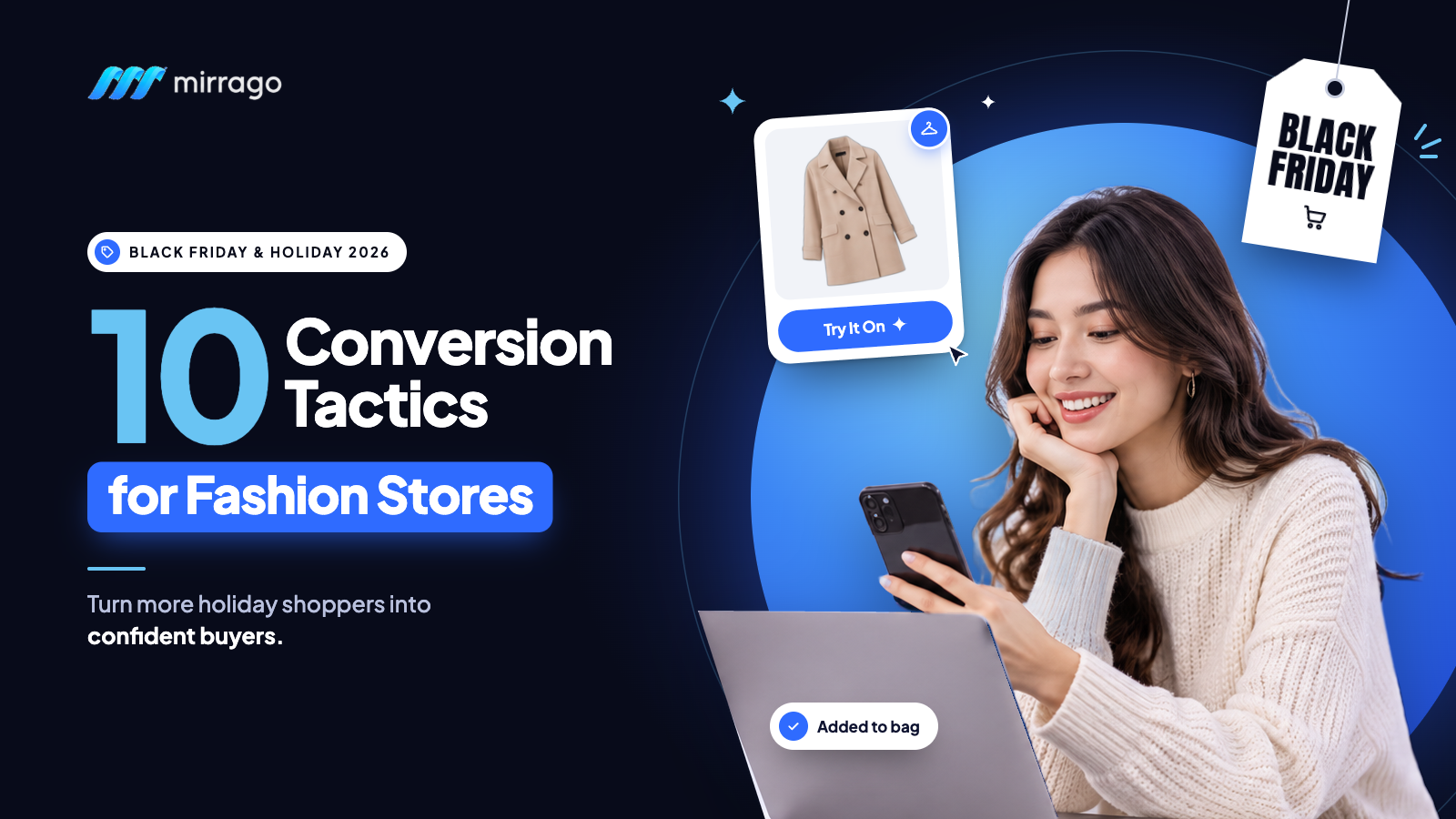
Black Friday and Holiday 2026: 10 Conversion Tactics for Fashion Stores
Every November, fashion stores see a traffic surge as shoppers hunt for the best Black Friday deals. Ad spending increases, more products are added to carts, and interest in holiday shopping grows. However, turning that traffic into sales can still be challenging.
The gap between visits and purchases often comes down to uncertainty. Online shoppers cannot feel the fabric, see every detail in person, or try on an item before buying. As a result, they may hesitate, compare other options, and leave without completing their purchase.
With the right Black Friday marketing strategies, fashion stores can reduce this hesitation and create a smoother shopping experience. Black Friday 2026 falls on November 27, followed by Cyber Monday on November 30, giving businesses time to prepare their stores and campaigns.
In this guide, we'll share 10 practical conversion tactics for fashion stores, covering everything from pre-sale marketing and product page optimization to checkout, promotions, and post-purchase follow-up. Most of these improvements can be implemented in seven days or less.
1. Start Early with a Black Friday Teaser and Wishlist Campaign
Those who sell the most on Black Friday don't open on Black Friday. In the weeks leading up to it, they build a list of those who already want something.
Build an Email and SMS Subscriber List Before the Sale
Create a basic pre-sale landing page, and one of its missions is to grab emails and phone numbers. Provide a compelling explanation for subscribing, for example, better access to the sale, a first look, or a little extra for those who subscribe. Then share the page on Instagram, Facebook, on your homepage banner, and in order confirmation emails.
Offer Early Access and Wishlist Reminders
Give shoppers the option to add products to their wishlists and let them know when they are on sale. This is because the customer already has a vested interest. All you are doing is reminding them at the right time.
Create a teaser page with a launch date.
Collect email and SMS sign-ups with a clear benefit.
Give subscribers early access to selected products.
Send wishlist reminders when saved items are discounted.
Example: A customer saves a wool coat in early November. On Black Friday morning, she gets a short message that the coat is now on sale. She is far more likely to buy than someone who sees it for the first time in a crowded feed.
2. Optimize Fashion Product Pages Before Holiday Traffic Arrives
Your product page does the job of a shop assistant. In a physical store, a customer can feel the material and look at the item from every side. Online, the page has to do that work.
Fixing product pages before the traffic arrives is one of the most cost-effective Black Friday marketing strategies for fashion stores, because every ad click lands on one.
Use High-Quality Product Images and Multiple Angles
Show the front, the back, and at least one close-up of the fabric. Add a photo of the item being worn, and include a short note about the model, such as height and what she is wearing. If you can, add a short video of the item moving.
Add Fabric Details, Fit Notes, and Clear Return Policies.
Tell shoppers what the item is made of and how it feels. Is it stretchy, lined, heavy, or lightweight? Describe the cut in plain words, such as relaxed, fitted, or cropped.
Show shipping costs and delivery times on the page.
Make the return policy easy to find, not buried in the footer.
Write clear descriptions with fabric, care, and fit notes.
Show availability honestly.
Example: A shopper looking at a winter jacket should be able to see the material, thickness, lining, and available colors without messaging customer support. If she has to ask, many others will simply leave.
3. Add Virtual Try-On to Help Shoppers Choose with Confidence
Product photos show how a garment looks on a model. Shoppers still wonder how it will look on them. Virtual try-on closes part of that gap.
Let Customers Visualize Clothing Before Buying
AI-powered virtual try-on lets a shopper upload a photo of themselves and preview a garment on it. Tools like Mirrago do this inside the product page, so the shopper does not need to leave your store or download anything. The preview does not replace good photos and clear descriptions. It adds one more way to judge a piece before buying.
It is worth being realistic here. A visual preview supports a decision, but it does not guarantee a perfect result or remove every return. Present it as a way to help shoppers feel surer, not as a promise.
Start with best-selling and high-traffic products.
You do not need to switch it on for your entire catalog first. Start where the traffic is.
Enable it on your top-selling dresses, tops, and jackets.
Add it to giftable items, since gift buyers are often less sure about what will suit the person.
Place the button near the main product image so shoppers see it without scrolling.
Mention it in your sale emails and social posts, so people know it exists.
Example: A shopper eyeing a party dress for a December event can preview it on herself, check the color against her skin tone, and decide before adding it to the cart.
4. Display Customer Reviews and Social Proof Prominently
When shoppers cannot handle the product, they rely on other people. Reviews are the closest thing online stores have to a friend saying, “Yes, buy it.”
Showcase Customer Photos and Verified Reviews
Photos from real customers are more convincing than studio shots because they show the garment in normal light and on normal bodies. Ask for photos in your post-purchase emails and feature the best ones on the product page. Mark reviews as verified when they come from real buyers.
Highlight Fabric Quality and Customer Experiences
Pull useful lines to the top, such as comments about fabric feel, warmth, color accuracy, or how a piece held up after washing. A review that says “the color matches the photos” answers a question many shoppers have.
Add verified reviews to every key product page.
Show real customer photos.
Surface comments about fit, fabric, and quality.
Add trust signals near the checkout button, such as secure payment badges and a visible return policy.
Keep it honest. A page with a few real reviews is better than one filled with generic praise.
5. Create Urgency with Honest Black Friday Deals and Stock Updates
Urgency works when it is true. Shoppers know the difference, and regulators in several markets, including the US Federal Trade Commission, treat fake countdowns and false scarcity as deceptive.
Use Countdown Timers for Limited-Time Offers
If a sale really ends on Cyber Monday at midnight, say so, and show a timer that matches. Do not reset a timer every time a visitor comes back.
Show Real-Time Stock Availability
Fashion stock is limited by nature, so low-stock notes can help when they are accurate. A message like “Only 3 left in this color” only works if it is true.
Show real sale end dates.
Use accurate stock counts.
Highlight limited-time offers clearly.
Avoid fake timers and invented scarcity.
Honest urgency also protects your brand. Customers who feel tricked on Black Friday do not return in January.
6. Increase Average Order Value with Fashion Bundles and Gift Guides
Getting a shopper to buy is one win. Getting her to buy two or three items is where the margin improves.
Create Complete-the-Look Product Bundles
Pair a dress with a belt and earrings, or a coat with a scarf and gloves. Show the full outfit on one page and offer a small bundle discount. Shoppers often like the idea of a ready-made look, especially during a busy season.
Build Holiday Gift Guides by Budget and Occasion
Many holiday shoppers are buying for someone else, and they often do not know where to start. A gift guide gives them a shortcut.
Group gifts by budget, such as under $25, under $50, and premium.
Group by occasion, such as office parties, family dinners, and winter weddings.
Recommend complementary products without crowding the page.
Link each guide from your homepage and sale emails.
Keep suggestions focused. Three well-chosen add-ons convert better than a long list of random items.
7. Simplify Mobile Shopping and Checkout
On Black Friday, a large share of fashion shoppers browse and buy on their phones. A slow or awkward mobile experience costs sales you have already paid to attract.
Optimize Product Pages for Mobile Devices
Test your store on a real phone, not only in a desktop preview. Check how quickly the pages load, whether the images are sharp, and whether buttons are easy to tap with a thumb.
Compress images so pages load fast.
Keep the add-to-cart button visible as the shopper scrolls.
Make sure photo galleries are easy to swipe.
Reduce Checkout Steps and Enable Guest Payments
Forcing shoppers to create an account is one of the quickest ways to lose them.
Offer guest checkout.
Support digital wallets such as Apple Pay and Google Pay.
Remove any form field you do not truly need.
Show shipping costs before the final payment step, so there are no surprises.
Run a test order on your own phone this week. You will probably find at least one thing to fix.
8. Recover Abandoned Shopping Carts with Timely Reminders
Most people who add something to a cart do not buy it right away. According to the Baymard Institute, which has studied checkout behavior for years, the average cart abandonment rate is around 70 percent. During a sale, many of those shoppers are simply comparing prices or waiting to see if a better deal appears.
Send Personalized Cart Recovery Emails
Send the first reminder after a few hours, not a few minutes. Include the product image, name, and a clear "back to cart" button. Keep the tone helpful, not pushy.
Use SMS Reminders and Relevant Incentives
If a shopper has opted in to SMS, a short text can work well. When the sale really is about to end, say so.
Send the first reminder after a reasonable delay.
Include product images and a direct cart link.
Mention the sale end date, but only if it is accurate.
Save any discount for a later reminder, and only when margins allow.
Limit the number of messages so you do not annoy people.
A shopper who gets three reminders in one afternoon is more likely to unsubscribe than to buy.
9. Protect Profit Margins with Smarter Holiday Promotions
More discounts do not always mean more profit. A sitewide 40 percent off can fill your order list while leaving little behind after shipping, ads, and returns.
The strongest Black Friday marketing strategies for fashion stores plan the math first. Decide how much margin you can give up on each category before you announce anything.
Use Tiered Discounts and Free Shipping Thresholds
Tiered offers reward bigger baskets. For example, 10 percent off orders above $75 and 15 percent off orders above $120. A free shipping threshold set slightly above your average order value nudges shoppers to add one more item.
Prioritize Promotions Based on Inventory and Profit Margins
Discount slow-moving stock first.
Bundle slow sellers with popular items.
Promote selected categories instead of marking down everything.
Calculate the profit on each offer before it goes live.
Example: If knitwear has strong margins and plenty of stock, lead with it. If a new collection sells well at full price, leave it out of the sale and protect that revenue.
10. Improve Post-Purchase Experience and Manage Holiday Returns
The sale does not end at checkout. What happens next decides whether the customer comes back and whether she leaves a good review.
Set Clear Delivery Expectations and Order Updates
Holiday shipping is busy. Give realistic delivery dates and update them if something changes. Send an order confirmation straight away and a shipping notice with tracking.
Make Returns Easy and Encourage Repeat Purchases
A clear, simple return process reassures shoppers before they buy and keeps them loyal afterward. Explain how returns and exchanges work in plain language.
Communicate honest delivery timelines.
Send confirmation and shipping emails.
Explain return and exchange steps clearly.
Ask for a review after delivery.
Follow up with relevant product suggestions and loyalty offers.
Customers who have a smooth experience are the easiest to win again, and they cost far less than new ones.
Turn Holiday Traffic into More Confident Fashion Purchases
Strong holiday sales come from more than big discounts. They come from product pages that answer questions, a checkout that feels easy, offers that protect your margin, and service that continues after the order.
The best Black Friday marketing strategies for fashion stores work together, so you do not need to do all 10 at once. Start with the pages and steps your shoppers use most.
Before November 27, review your five most visited product pages, test your mobile checkout, and check that every promotion makes financial sense. If you want to help shoppers feel surer about what they are buying, a virtual try-on tool such as Mirrago is one option to consider alongside the rest.
A few small fixes this week could make a real difference when the traffic arrives.