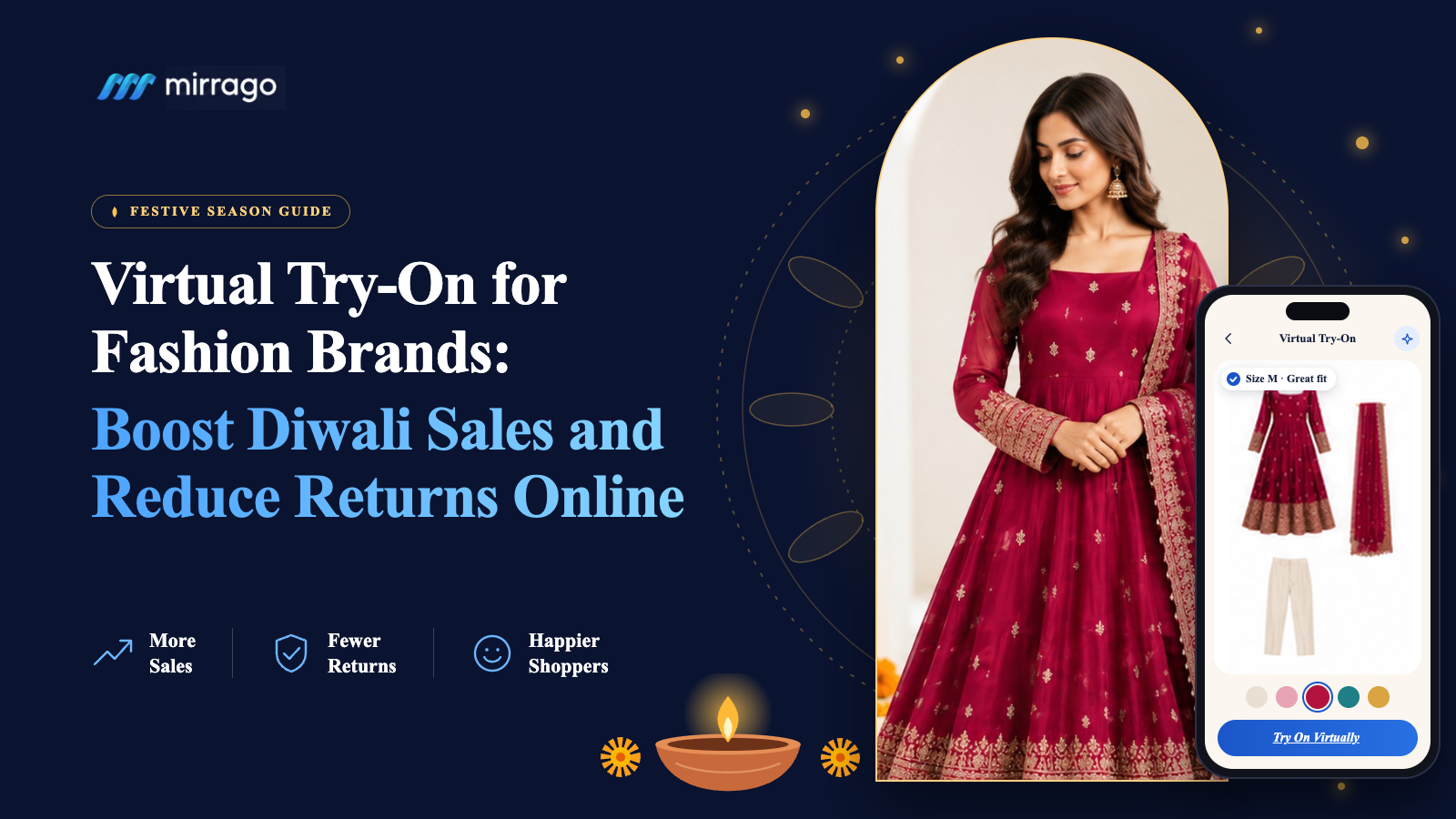
A shopper finds a green silk kurta she loves but isn’t sure how it will look on her. She checks the photos, hesitates, and leaves without buying. For fashion brands, moments like this mean lost sales.
Virtual try-on for fashion brands helps shoppers visualize outfits before buying, making online shopping more engaging and confident.
During the 2025 festive season, India’s e-commerce order volumes grew by 24% over the year, according to Unicommerce. More demand brings more opportunities, but also greater pressure to manage returns.
With Diwali falling on November 8, 2026, now is the time to explore how virtual try-on can help increase festive sales and improve the online shopping experience.
Why Diwali Is Both Your Biggest Opportunity and Biggest Risk
Diwali is one of the busiest times for fashion stores. Hansa Research sources say in a festive shopping update that 69% of shoppers will be shopping for fashion articles throughout the season. The more customers, the more sales possibilities, yet likewise the more rivalry and the more risk of returns when customers don't realize the things they're shopping for fit or look.
Three patterns raise the risk:
Gifting: They purchase gifts for people that are somewhat unknown to them.
Multiple Items/Orders: If one family places an order and any of these items are a sari, kurta, and children's wear, a single fit issue may result in multiple items being returned.
Competition in the marketplace: Small brands have to provide customers with assurances when pitching their products against the easy returns that big platforms provide.
Returns often arrive after the festive rush, when teams are exhausted, cash is tied up in reverse logistics, and the cost of every order becomes harder to ignore.
Why Customers Return Fashion Orders Online
Most fashion returns come from doubt, not from bad products. The shopper imagined one thing and received another.
Style doubt: The shopper is unsure whether the outfit suits them, so they order and decide at home.
Color and fabric mismatch: Studio lighting can make a deep maroon look brighter than it is, and a silk blend may feel less soft than the photo suggests.
The expectation gap: The shopper sees a lehenga on a model and cannot tell how it will look on them.
Cost is not limited to a refund. Repackaging and reverse logistics costs. Goods during the festive season can lose value rapidly after it ends. Requests for exchange are dealt with by support teams. And an unhappy customer has no intention of returning for the next sale.
For context, the US National Retail Federation has reported that online return rates run well above in-store rates. Your own order data is the number that matters most.
What Is Virtual Try-On? (And What Types Exist)
Virtual try-on for fashion brands technology allows customers to view how a product might look on them prior to purchase. There are multiple technologies that are all applied through the label, and these technologies address different problems.
This works by measuring height and weight and/or body measurements and recommending a size. Their role is to aid fit, not appearance.
AR try-on
The shopper’s camera overlays the product in real time on their face, hands, or feet. It works best for eyewear, jewelry, and footwear.
Model or avatar-based try-on
The shopper picks a model or avatar and sees the outfit on it. No personal photo is required.
Photo-based try-on
The shopper uploads their own photo, and AI shows the garment on them while keeping their pose and skin tone.
One honest rule
A try-on preview shows style, color, and overall look. It cannot show fabric texture or how a material feels. Use it as a confidence aid alongside clear photos and product details.
How Virtual Try-On Increases Diwali Sales
People do purchase when they are confident in their purchase. The overall idea of virtual try-on technology for fashion brands goes directly to that moment of uncertainty on the product page.
The purchase decision: When the kurta or saree is viewed individually, they will make their purchase decision more quickly, improving the conversion rate.
Extended engagement: If individuals try a few looks, you will hold their attention longer than a rival, and in that time they will compare your items rather than the rival's.
Complete look buying: If a customer buys a kurta, you can offer a matching jacket or dupatta in a single sitting, increasing average purchase value.
Better gifting: Customers can view a product on a model similar to the person they want to buy for to determine the look.
The results depend on your tools, website traffic, and product catalog. Treat virtual try-on as something to test and measure, not a guaranteed promise of higher sales or fewer returns.
How Virtual Try-On Reduces Returns
Virtual try-on cannot eliminate every return, but it can help reduce returns caused by a gap between what shoppers expect and what they receive.
Clearer product expectations: Shoppers can preview how an outfit may look on them before placing an order, helping them make more confident purchase decisions.
Fewer surprises after delivery: Seeing how a garment looks can help shoppers better understand its style, appearance, and overall look before buying.
Better product presentation: Customer feedback and return reasons can help brands identify products whose actual appearance differs from shoppers' expectations and improve their product images or descriptions.
It can also reduce the time customers spend asking questions about how an outfit might look, giving your support team more time to handle other requests during the busy festive season.
Before making claims about reduced returns, compare your store's return rate before and after introducing virtual try-on.
Where to Start: Best Use Cases for Festive Fashion
If you do turn it on for the whole catalog, please keep it off and on; otherwise, this may cause service issues. Begin at the point of maximum uncertainty.
Jewelry and accessories: Earrings, necklaces, and eyewear are great applications for real-time AR, and consumers enjoy viewing scale and placement.
Footwear: Showing festive shoes and juttis, which are bought to match an outfit, would help.
Gifting collections: Curated Diwali gift sets with a try-on feature to entice those who are thinking about ordering but leave the items at home.
How to Implement Virtual Try-On Step by Step
Start small, measure the results, and expand once you know what works.
Review your return data. Check the last six months of returns and identify products most often returned for look, color, or style-related reasons.
Choose the right try-on solution. Photo-based try-on works well for visualizing outfits, while AR try-on suits accessories.
Prepare your product data. Use clear, well-lit product images and accurate fabric, color, and styling details. Better product information gives shoppers a more useful preview.
Integrate it with your store. Choose a solution that works with your ecommerce platform, whether you use Shopify or WooCommerce.
Test on mobile devices. Make sure the feature loads quickly and works smoothly, even on slower internet connections.
Start with key products. Launch virtual try-on on 10–20 popular products with high traffic or frequent returns before expanding across your catalog.
Measure and improve. Track conversions, return rates, and customer engagement over the next two to four weeks. Use the results to decide which products to add next.
Beyond Try-On: Supporting Elements That Boost Results
Try-on works best as one part of a confident shopping journey.
Clear product details: Show fabric, color, and styling notes so the preview and the description agree.
Real-light photography and short videos: Show how fabric moves and how color looks in daylight.
Fast, mobile-friendly checkout: Remove friction once the shopper is convinced.
WhatsApp or chat support with easy exchanges: A quick answer saves a sale, and an exchange policy lowers risk.
Personalized recommendations and bundles: Suggest matching pieces after a try-on.
Metrics to Track
Set a baseline before launch, then compare try-on users with shoppers who did not use it.
Conversion rate on try-on enabled pages
Return and exchange rate, overall and by return reason
Average order value
Try-on usage rate
Support ticket volume
Net revenue after returns
What matters most is net revenue after returns. Once a sale comes back, the revenue you thought you earned may disappear.
Common Mistakes to Avoid
Poor product data: Dark, inconsistent photos or inaccurate color and fabric details cancel out the benefit of the preview.
Slow load times: Heavy tools frustrate shoppers and can hurt page speed.
Ignoring mobile users: Check the upload flow and buttons on small screens.
Launching everywhere at once: You cannot tell what works, and one problem spreads across the catalog.
No measurement plan: Without a baseline, you will not know whether it paid off.
Festive Readiness Checklist
Use this before your next sale.
Top returned categories identified from the last six months
Product photos are clean, consistent, and well lit
Try-on type chosen and tested on 10 to 20 bestsellers
Mobile speed and upload flow tested on real phones
Exchange policy clear and visible on product pages
Support team ready for fit and size questions
Baseline numbers recorded for conversion, returns, and order value
How We Can Help
At Mirrago, we work on virtual try-on for fashion brands that sell on Shopify, WooCommerce, or their own platform. If you are unsure where to begin, we can help you review your return data, pick the right try-on approach, connect it to your store, and set up simple tracking so you can see what changes.
If you would like to talk it through, book a free virtual try-on consultation. You can also use the checklist above on your own, or reach out to our team about reducing your return rate.