The Virtual Try-On Decision Framework: Build In-House or Buy an API?
All retail tech teams at some point end up at this fork in the road: build our very own AI virtual try-on feature or make use of a virtual try-on API platform that has already addressed the problem?
First impressions indicate that in-house construction equates to complete control of the architecture and ownership. It feels like a long-term solution until one actually considers the actual capital requirement. The objective question isn't really what it's about, whether it's owned or not, but what it is about efficiency, which path provides the best return on investment (ROI) over the next 3 years
This deep dive has been written for engineering and product leaders who require facts, not opinions. We will examine the true costs of an internal machine learning pipeline, discuss the economics of a production-ready API, and give an objective decision process.
Our goal isn't to sell you a product; it is to help you make the right strategic call for your engineering team so you do not get burned by hidden expenses down the road.
What Does a Virtual Fitting Room Require?
Before you can build an accurate budget, you need to understand what an enterprise-grade virtual try-on system actually involves. It is never just a single artificial intelligence model sitting on a cloud server. Instead, it is three deeply connected software subsystems that must process raw data in real time to deliver a high-fidelity image to your user in less than four seconds.
Here are the three AI Image Pipelines
Garment Mapping: This layer analyzes flat photos of clothing. It calculates fabric textures, color depth, and how the material drapes naturally, enabling the software to convert standard product photos into structured 3D data.
Diffusion Networks: This is the generative AI core. It synthesizes the final image of the clothing on a person. Achieving lifelike details and lighting in under 4 seconds requires highly optimized machine learning models and custom GPU engineering.
Body Segmentation: This final piece tracks body shapes, poses, and physical measurements. It extracts the shopper's silhouette to ensure garments wrap accurately around shoulders and waists instead of appearing flat or photoshopped.
The Hidden Costs of Building In-House
Most software teams create budgets based only on what they can see clearly from day one: base engineering salaries and monthly cloud storage bills.
The things hidden under the water are what routinely kill a custom software project. The iceberg is like this, its top is easy to plan, but the bottom is huge, and it's the bottom that makes the boat sink.
Here are the Three phases of hidden costs:
Phase 1: The AI Talent Hunt
Building from scratch requires specialized, high-cost talent rather than general developers. A minimal engineering team carries heavy annual baseline costs:
2 Senior ML Engineers (Diffusion Specialists): $320K - $460K combined
1 Computer Vision Specialist: $130K - $200K
2 Full-Stack Developers: $230K - $300K combined
1 DevOps Cloud Engineer: $160K - $200K
This drives base payroll to $1.0M - $1.36M annually before benefits or recruiting fees. In a tight market, sourcing this team takes 3 to 6 months, burning half a year before any customer-facing code is even shipped.
Phase 2: Server Infrastructure and Wasted Power
Training custom models requires 500 to 2,000 cloud GPU hours ($2-$4/hr) for every new collection launch or bug fix. The bigger financial drain is seasonal traffic. To handle massive holiday spikes like Black Friday, you must buy peak server capacity. This leaves expensive GPU clusters running at less than 20% utilization during slow months, forcing you to pay full price for completely idle hardware.
Phase 3: The 30% Continuous Upkeep Tax
The rate of evolution of Generative AI frameworks is so fast that the performance of unmaintained models fades rapidly. Expect to spend about 30% of your initial build investment to keep pace with industry changes on an annual basis. If this is not accomplished regularly, the users' experience will be slow and unstable in 18 months, compromising your competitive advantage.
How Businesses Save Money and Grow Faster with an API
Using an external API converts all of those unpredictable infrastructure headaches into a single, clean operational expense. Every single background cost and server management, continuous AI training, security audits, and system updates are completely absorbed by the platform infrastructure and spread across thousands of global clients. You pay purely for the final output, not the heavy machinery required to build it.
Completely Predictable Pricing: Instead of risking over a million dollars upfront, you access the system through volume-based tiered payment structures. There are no sudden server bills, no fees for idle computers, and no financial penalties when traffic slows down.
Zero Infrastructure Waste: Your financial team can model your exact expenses months in advance, just like a standard software subscription. When your sales drop during off-peak months, your tech expenses drop automatically alongside them.
Instant Technical Upgrades: Any time there is a change in the base image quality or the processing speed of the application, your application updates automatically. Without having to write a single line of new code, your customers have a better experience.
Faster Development: Launch Virtual Try-On in Days, Not Months
Integrating a professional API requires no machine learning or data science background from your current development team. A standard implementation, which involves sending an image of a shopper and a photo of a dress, and then receiving a combined image, can be completed in less than two weeks.
Your current software engineers simply connect a basic data endpoint to your online shopping cart and instantly move back to working on your core business features, like improving checkout speeds or optimizing your mobile app layout.
The Financial Reality: Build vs. Buy
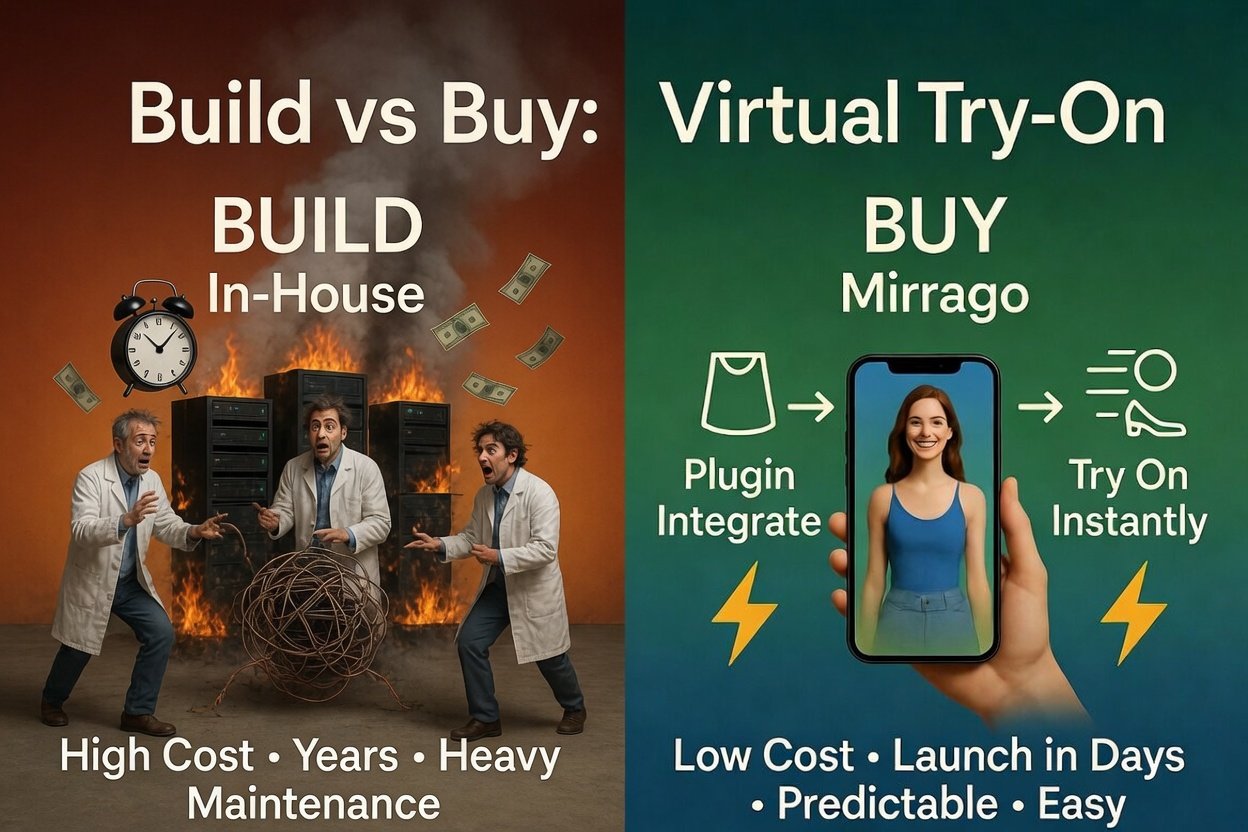
When adding an AI Virtual Try-On tool to your e-commerce store, the biggest decision you will face is resource allocation: Should you build this technology from scratch, or integrate a ready-made platform like Mirrago?
From an industry standpoint, building a proprietary AI pipeline internally is rarely viable for mid-market retail brands. The true cost of self-development stretches far beyond standard software coding. It forces companies into heavy, long-term operational liabilities, including:
Development & Engineering Payroll: Sourcing, hiring, and retaining highly specialized Machine Learning and Computer Vision engineers who command premium tech salaries.
Continuous Upkeep & Maintenance: Constantly rewriting code to keep up with rapidly changing AI frameworks, optimization fixes, and fixing system breakdowns.
Operation Management & Infrastructure: Managing complex GPU server loads, handling data pipeline traffic spikes during sales seasons, and maintaining strict security compliance.
Mirrago Predictable, Value-Based Pricing
In contrast, leveraging an established platform transitions your business from high-risk capital expenses to predictable, scaled growth. To help fashion brands evaluate the rendering quality and integration impact completely risk-free, all standard tiers include a 2-week free trial.
Mirrago provides a clear and flexible 4-tier pricing structure designed to align with your exact business scale:
Tier | Monthly Price | Try-ons Included | Best For |
Starter | $29.99 | 150 | Boutique retailers |
Growth | $49.99 | 300 | Emerging brands |
Pro | $99.99 | 750 | Mid-market stores |
Enterprise (White-Label) | Custom | Custom | Premium solution with white-label portals, co-branded campaigns, R&D labs, and custom API volumes. |
A production-ready API ensures that there are no issues to deal with on the backend and reduces the amount of time taken to launch from months to days. The additional “try on” is charged a simple, clear price of $0.10, while you won't need to worry about any hidden costs, your budget is fully predictable, and you can concentrate solely on your revenue-generating efforts.
Virtual Try-On Strategy: Build Your Own or Use an API?
This analysis is intentionally balanced. Developing your own custom virtual try-on software pipeline is not always the wrong business move. However, it is only the correct decision under a very specific set of corporate circumstances. Use this simple matrix to see exactly where your business stands today.
When You Should Choose to Build In-House
Hyper scale Volume: Your storefront already processes more than 50,000,000 unique user sessions every year, where massive volume eventually changes server unit economics.
Core IP Strategy: Owning proprietary, raw body-measurement data maps directly to your long-term venture capital strategy or board-level funding requirements.
Existing Free Resources: You already have a massive team of unallocated data scientists on your company payroll with completely free, pre-paid GPU server clusters available.
When You Should Choose to Buy (The API Path)
It Matters: Your brand must roll out a high-quality virtual try-on experience within weeks of the market to beat it or take advantage of a surge of sales during the holidays.
Lean Engineering Teams: Your existing developers know a lot about web design, mobile apps, and e-commerce, but not so much about data science or neural networks.
Smart Capital Allocation: Rather than investing your capital into backend server racks, you want to invest it into areas that can have a larger impact on your business, in this case, product design, inventory growth, or digital marketing campaigns.
Financial Security: Your leadership team wants to know what it costs to run your product each month and to know that it will continue to cost the same amount.
Conclusion
Deciding between building your own system or using an API comes down to one thing: how you want to spend your budget.
Building everything from scratch takes years and costs millions of dollars in hidden server fees and engineering salaries. By choosing a ready-made API like Mirrago, you save those resources and can invest them directly into buying inventory, marketing your products, and growing your sales. The hard technology problem is already solved—the only question is how fast you want to use it to scale your brand.
Ready to Add AI Virtual Try-On to Your Store?
Don't spend months building what already exists. Mirrago API gives your customers a smarter, more confident shopping experience and your business a measurable edge.
Faster integration
Lower investment
Higher conversions
Fewer returns
Explore Mirrago and book a Demo Today and start delivering the future of fashion retail.