How Fashion Influencers Can Use AI Virtual Try-On for Content Creation (Without Visiting Every Brand Store)
Suppose you are a fashion influencer and you are collaborating with five clothing brands for the month. But before you even start creating content, the week fills up with logistics. Visiting different stores, waiting for deliveries, planning photo shoots, trying on dozens of outfits, and packing up and returning clothes that you borrowed to the stores when the campaign is over. When one collaboration ends, another trend has invaded your feed.
Most people don't realize the real downside of influencer marketing. Creativity doesn't slow creators down; it's the logistics.
AI Virtual Try-On is transforming that process in an unobtrusive way today. Rather than receiving physical clothes, influencers can now get product images or just peruse a brand's online retail store and create realistic outfit visuals from the comfort of their own home.
This leads to quicker content creation, more brand partnerships, and undeniably reduced campaign expenses for fashion brands. This change is no small convenience. It's revolutionizing influencer marketing from the ground up, and creators who get a handle on it now will be at an advantage.
Why Traditional Fashion Influencer Campaigns Take So Much Time
It's useful to know where time is lost in a typical campaign before you see the solution.
Finding the Right Brand
Finding a brand that aligns with the influencer and their audience takes research, outreach, and negotiations, sometimes taking days or weeks to get everything right before a single piece of content is even conceived.
Visiting Physical Stores
When a partnership is agreed upon, someone has to go to a store or showroom to select pieces, which consumes a creator's already busy schedule.
Waiting for Product Deliveries
But when a brand sends products, influencers must wait for their products to arrive, follow up on tracking numbers, and then wait for the window to open to meet content deadlines.
Planning Photoshoots
Lighting, place, camera setup, and sometimes another person behind the camera are all necessary for every outfit. Multiply this by five brands.
Returning Borrowed Products
Once the campaign is over, lots of creators should repack and send items back, and that's one more thing to be done.
This can leave even the most talented and quick influencers with just a few projects to work on per month.
How AI Virtual Try-On Changes the Entire Content Creation Process
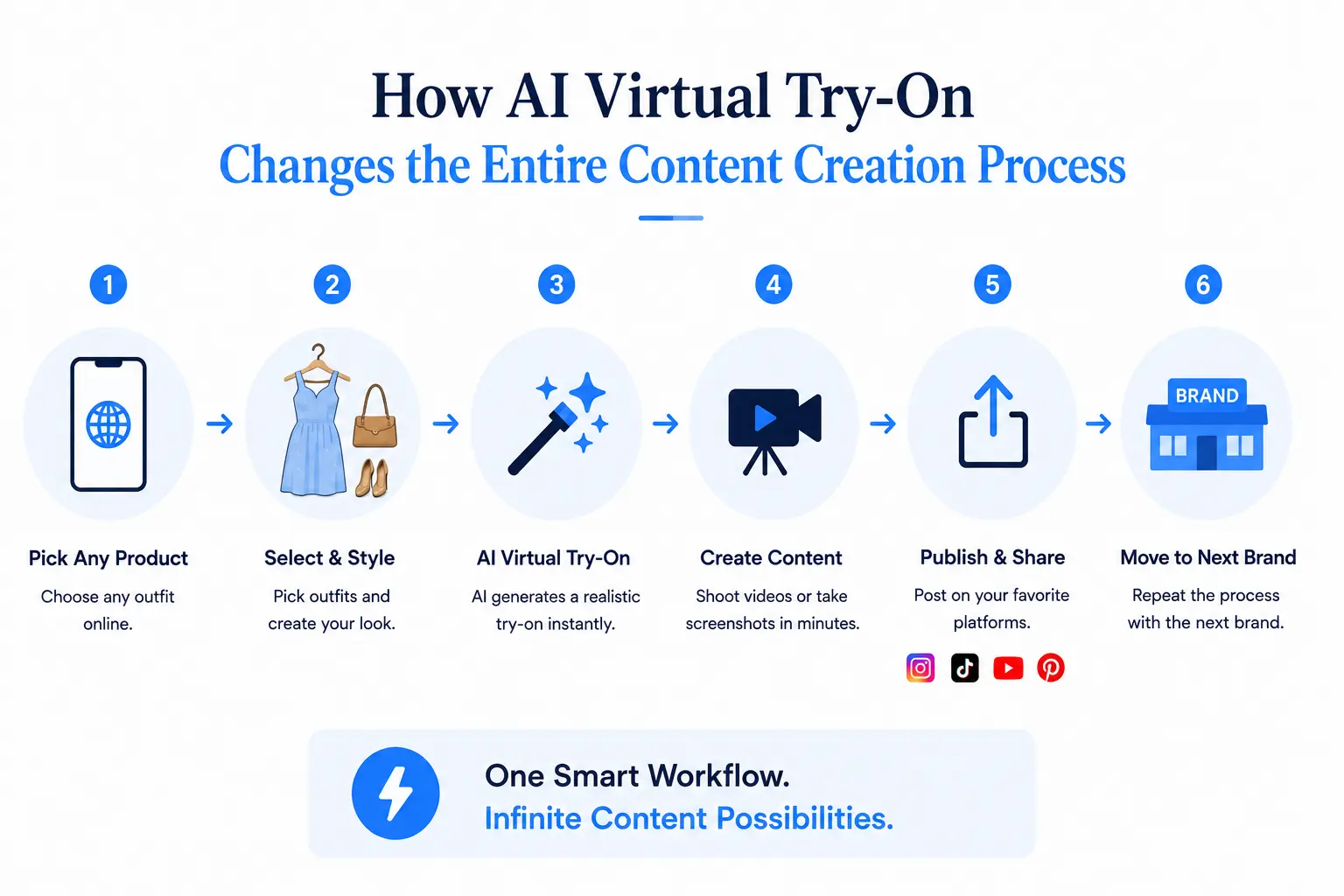
Put the two workflows side by side, and the difference is impossible to miss.
Step | Traditional Workflow | AI Virtual Try-On Workflow |
1 | Visit the store | Browse the online store |
2 | Collect clothes | Select an outfit. |
3 | Photoshoot | Generate AI try-on |
4 | Editing | Create video |
5 | Return products | Publish |
6 | Publish | Move to next brand |
This isn't a small trend either, industry data shows the virtual try-on market is projected to grow significantly through 2030, and brands are moving fast to adopt it
Here is what actually disappears when a creator switches over:
No store visit. The outfit is picked from a screen, not a rack.
No waiting on deliveries. There is nothing to ship, so there is nothing to wait for.
No returns to pack up. Nothing physical ever leaves the brand's warehouse.
No lost days between steps. What used to take a week of back-and-forth now runs start to finish in one sitting.
The creative part of choosing an outfit, styling a look, and the story you tell is the same. What’s gone is everything around it that never actually made the content better to begin with.
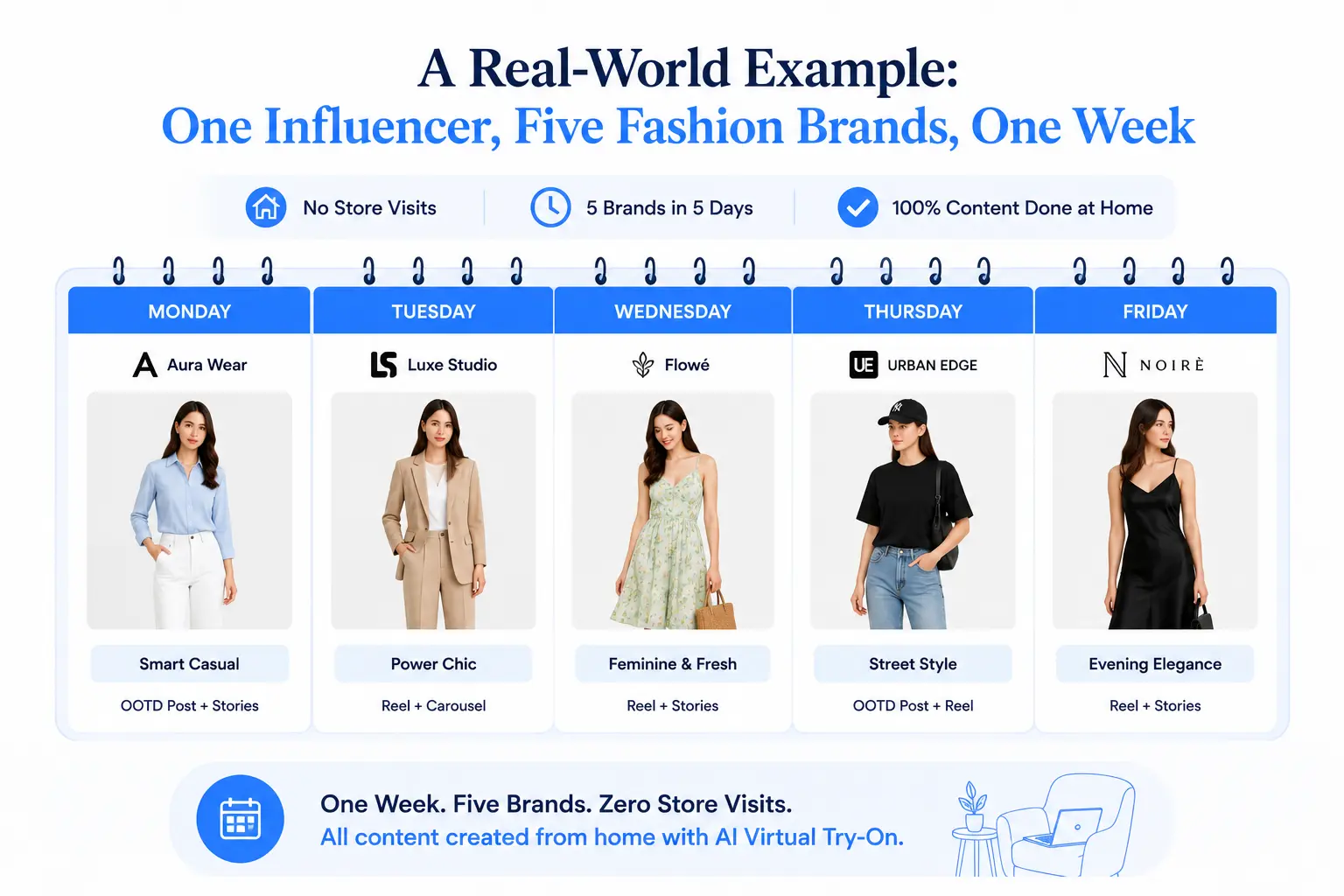
A Real-World Example: One Influencer, Five Fashion Brands, One Week
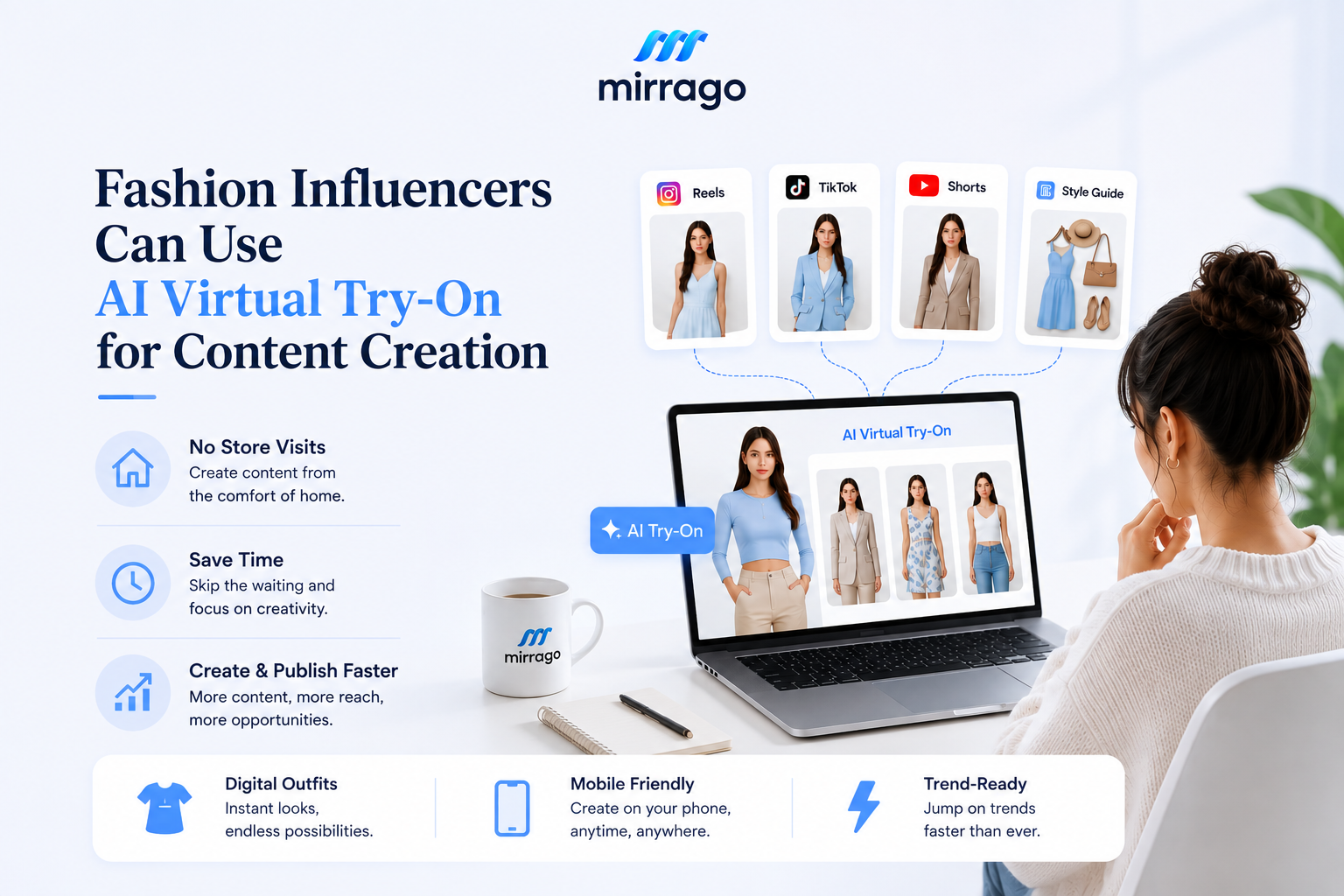
Let’s say you’re a fashion influencer. You’re collaborating with five different brands in one week. You’re not going into each store. You’re not waiting for product deliveries. You're browsing each brand's website, selecting your favorite outfits, and using AI Virtual Try-On to create the looks.
From those digital outfits, you shoot Instagram Reels, TikTok videos, YouTube Shorts, styling tips, and outfit comparison posts, all from home. And in just five days, you've completed several brand campaigns and created content that would have normally taken weeks.
Types of Fashion Content Influencers Can Create with AI Virtual Try-On
Outfit Reels: used to need multiple photoshoots, now generated in minutes
Seasonal Lookbooks: used to need a large physical wardrobe, now just digital outfits with no storage needed
Styling Tutorials: used to mean many manual clothing changes, now instant outfit swaps on screen
Brand Reviews: used to require product shipment; now digital previews the same day
Trend Videos: used to be limited by available inventory; now unlimited outfit combinations
Outfit Comparisons: used to need several physical outfits on hand; now AI-generated variations are shown side by side
Benefits of AI Virtual Try-On for Fashion Influencers
The advantages go well beyond saving a few hours here and there.
Save travel time: no need to visit stores or wait around for deliveries
Collaborate with more brands: each partnership takes less effort to fulfill, so more collaboration can be done in the same month.
Test outfit ideas faster: multiple looks before committing to one final version, leading to stronger content
Join trends on the same day: no waiting a week for a sample to arrive before jumping on what's popular
In the end, creators save time, collaborate with more brands, and increase their earning potential all without working longer hours. With fewer logistics to manage, they can focus on creating content that grows their audience.
Why Fashion Brands Benefit Just as Much
This is not only a win for influencers. Brands see real savings too.
Traditional Campaign Cost | AI Virtual Try-On Campaign |
Shipping garments to each creator | Sharing digital product images |
Maintaining sample inventory | Using the existing catalog |
Handling product returns | No returns to manage |
Coordinating logistics across creators | Minimal coordination needed |
Slow scheduling around delivery times | Faster execution, no delays |
Working with a limited number of creators | Running campaigns with many creators at once |
For a marketing manager or brand owner, these are not small line items. Shipping, sample management, and returns processing quietly consume a large share of influencer marketing budgets, and AI Virtual Try-On removes most of that overhead entirely. Industry data backs this up too; brands using realistic AI-powered visualization have reported return rate drops of up to 40%.
How AI Virtual Try-On Helps Fashion Brands Scale Influencer Marketing
Brands that adopt AI virtual try-on tend to see improvement in a few specific areas:
Faster campaign launches, with no shipping timeline to plan around
Lower marketing costs, since garments, packaging, and courier fees drop out of the budget
More influencer partnerships at once, no longer capped by sample inventory
Easier international collaborations, since shipping costs and customs delays are no longer a factor
Every product in an online store becomes available for content creation, not just the items sent as samples. Brands can also test campaigns digitally before shipping any inventory, reducing costs and risk. The result is faster campaigns, better use of product catalogs, and a higher return on marketing investment.
AI Virtual Try-On Is Creating a New Era of Fashion Content
Zooming out, influencer marketing itself is changing shape. It is becoming:
Faster, with campaigns launching in days instead of weeks
Digital-first, built around online catalogs rather than physical samples
More scalable, supporting many creators at once
Less dependent on physical logistics that used to slow everything down
AI Virtual Try-On is more than a technology upgrade. It simplifies the entire content creation process, helping influencers create more while giving brands a faster and more cost-effective way to market their collections.
How Mirrago Makes AI Virtual Try-On Practical for Fashion Brands
Understanding the shift is one thing. Actually putting it to work in a live store is another, and this is where a platform like Mirrago fits in.
Built for the platforms brands already use: Mirrago ships as a WooCommerce plugin and a custom API along with a Shopify integration, so brands don't need to rebuild their stores to make try-on possible.
Mobile-first for creators and shoppers: A dedicated B2C mobile app that enables influencers and customers to generate try-on visuals from their phones without any software installation.
Flexible for different scales of collaboration: Free and Premium tiers let a brand start with a limited number of influencers and scale up as campaigns demand
Keeps the catalog front and center: Since try-on runs off existing product listings, every item a brand sells can be used as content, not just a curated sample set.
For a brand that’s already trying to figure out how to use AI Virtual Try-on for an influencer strategy, the question of technology feasibility is less about whether it works and more about how easily it can plug into the store and workflow they already have. That’s the gap that a solution like Mirrago is here to fill.
Conclusion
AI Virtual Try-On is revolutionizing the way fashion influencers and brands collaborate with each other. Creators no longer have to dedicate time and resources to store visits, shipping, and photoshoots, as brands can now produce more content from home and launch campaigns faster and at a lower cost.
With technology rapidly advancing, AI virtual try-on is making influencer marketing more efficient, scalable, and cost-effective like never before. Whether you're a fashion brand or content creator, now is the time to get started creating fashion content with AI Virtual Try-On.
Mirrago helps fashion influencers create engaging content from anywhere while giving brands a faster, more cost-effective way to launch influencer campaigns.
Explore how Mirrago can transform your next fashion campaign