How Customer Photos Are Handled in AI Virtual Try-On: What GDPR Really Requires
You upload a photo, choose a jacket, and a few seconds later, you see yourself wearing it. Simple, fast, and almost a little magical.
But have you ever wondered what happens to your photo after you click “Try On”?
An AI virtual try-on needs your image to create the experience. But using a photo to create a try-on is only part of the story. How that image is collected, processed, stored, and deleted matters too. That’s where AI virtual try-on privacy comes in.
As far as shoppers are concerned, the questions are easy: Where is my photo? Who is seeing my photo? Is my try-on photo used for anything other than my try-on? Understanding how these images are used is key to understanding AI virtual try-on privacy.
For fashion brands, it involves having some understanding of what data is being captured, the way it's being handled or processed, how long it's being stored, and whether or not the technology is compliant with the relevant GDPR criteria. This guide covers how customer photographs are processed in the AI virtual try-on and what brands need to understand about personal data, biometric data, and privacy.
What Happens to a Customer Photo During AI Virtual Try-On?
The process looks simple from the shopper's side, but a few distinct steps happen in the background every time someone tries on a garment.
From Photo Upload to Try-On Result
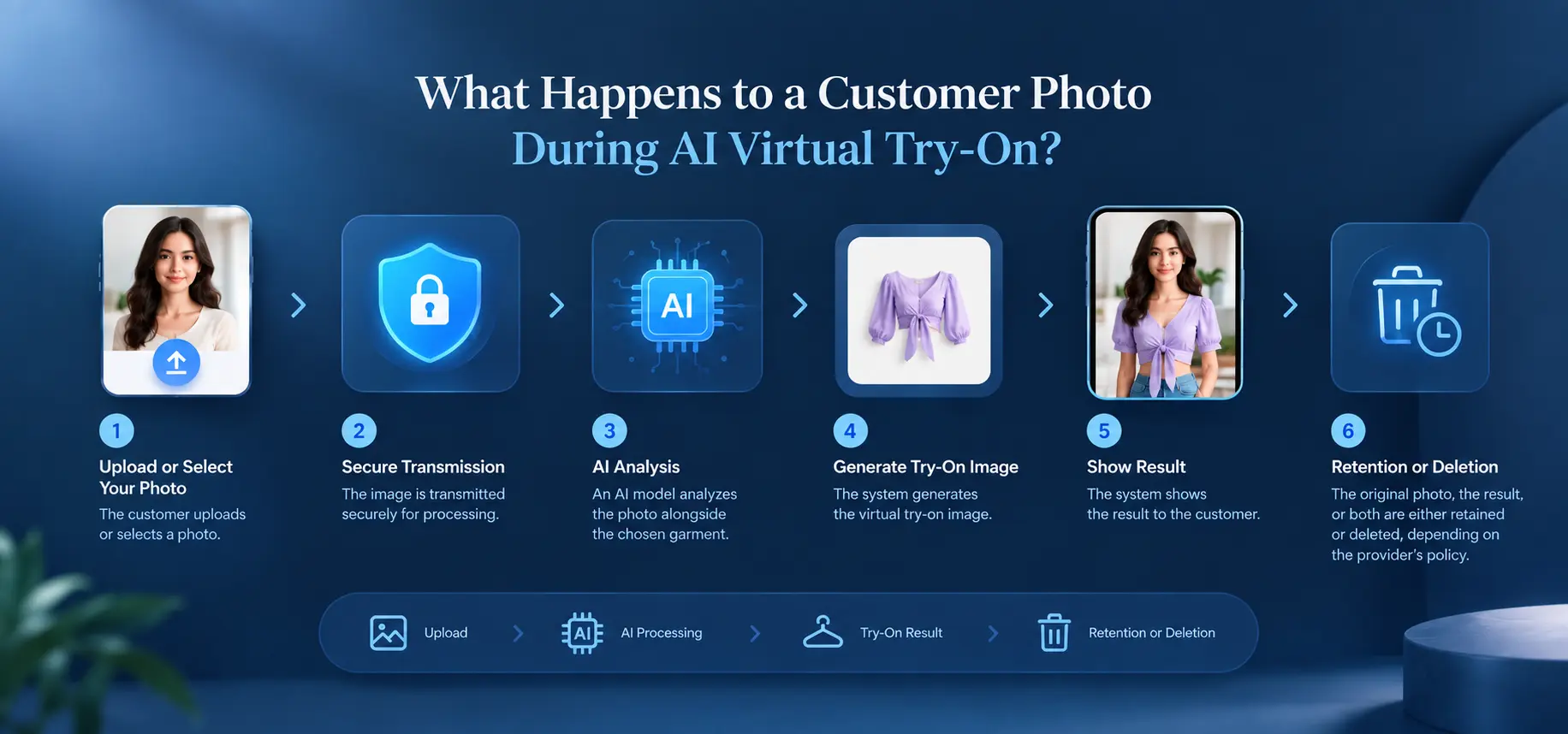
Here's the typical lifecycle:
The customer uploads or selects a photo.
The image is transmitted securely for processing.
An AI model analyzes the photo alongside the chosen garment.
The system generates the virtual try-on image.
The system shows the result to the customer.
The original photo, the result, or both are either retained or deleted, depending on the provider's policy.
A simple way to picture it:
Upload → AI Processing → Try-On Result → Retention or Deletion
Shoppers rarely think about that last step, and it matters most from a privacy standpoint. Whether a business collects only what it needs and gets rid of it afterward says a lot more about its approach to AI virtual try-on privacy than how realistic the render looks.
Are Customer Photos Personal Data Under GDPR? What Fashion Brands Need to Know
Yes, typically. According to GDPR, any image of a person's body or face that might enable identification of the person is considered personal data. This involves the same rules of privacy as with anything else: how it's obtained, why it's used, how it's stored, and who can access it.
Here's a distinction worth understanding, though: personal data is not automatically biometric data.
A photograph doesn't become special category biometric data just because a face is visible in it. What actually triggers that classification is specific technical processing used for unique identification, such as facial recognition matching one person against a database. The ICO's guidance on key data protection concepts explains this line clearly, and it's an important one for fashion brands to understand rather than assume.
Most AI virtual try-on tools generate an image; they don't identify a person against a database. That's a meaningful difference, and it's worth knowing rather than glossing over.
What Does GDPR Require for AI Virtual Try-On?
Rather than trying to summarize all of GDPR, it's more useful to focus on what actually applies to processing a customer's photo for a try-on feature.
1. A Clear Purpose and Lawful Basis
Before processing a single image, a business needs to know why it's doing so and which lawful basis supports that processing. It's not accurate to say "GDPR always requires consent." The right basis depends on the actual purpose, and for a feature the customer actively chooses to use, that basis can vary. What matters is that the business has actually thought it through, not defaulted to a generic answer.
2. Transparency
Customers should be able to find clear answers to a few basic questions:
What photo data is being processed
Why it's being processed
Who processes it
How long it's kept
Whether it's shared with any third party
If a shopper has to dig through a long privacy policy to find this, that's a sign the transparency isn't working as intended.
3. Data Minimization
Only what's genuinely needed should be collected. A virtual try-on feature needs a photo. Does it also need the customer's name, email address, or location just to generate an outfit preview? Usually not, and asking for more than necessary is one of the more avoidable mistakes a brand can make here.
4. Limited Retention and Deletion
If a photo is simply being used to create a try-on effect, there's not much reason to store it for an extended period of time. Where a privacy-conscious setup differs from a setup that hasn't faced the issue is the defined retention period and some actual deletion process.
5. Security
Practical safeguards matter as much as policy language. That includes encryption, access controls, secure data transmission, restricted internal access, and secure deletion once retention periods end.
The European Commission's overview of GDPR principles lists purpose limitation, data minimization, storage limitation, security, and accountability among the core principles that apply here, and they map directly onto how a customer photo should be treated from upload to deletion.
Are Virtual Try-On Photos Used to Train AI?
This is a question shoppers and brands both genuinely want answered, and it deserves a direct one.
The try-on using a photo the customer asked for is a specific and limited use. It's a completely different thing to use the same picture for "AI training" or to "AI improve" a model, and it shouldn't be confused as such because it's both using "AI processing."
It is important to ask the following question before selecting a virtual try-on service: Do your customers' photos power your AI models?
The answer should be clearly written and not in a footnote. That's a good indicator in and of itself if a provider can't give you a straight answer.
What Should Fashion Brands Check Before Choosing an AI Try-On Provider?
This is where the topic becomes practical for e-commerce teams evaluating vendors. Six questions cover most of what matters:
Where are customer photos processed?
How long are the original photos stored?
Are the generated try-on images also stored?
Are customer photos used for AI training?
Are third-party AI or cloud providers involved in processing?
Is there clear documentation covering GDPR responsibilities?
Two roles come up often in these conversations: the data controller (the business that decides why and how data is processed) and the data processor (the provider handling it on the controller's behalf). Where a virtual try-on vendor acts as a processor, a Data Processing Agreement should define exactly what it can and can't do with customer photos.
The European Commission notes that processors act on behalf of controllers, and that their responsibilities need to be set out through proper contractual arrangements, not assumed. For a brand adding virtual try-on, this is one of the more concrete things to check before signing anything.
Privacy by Design: What Good AI Try-On Should Look Like
Privacy works best when it's built in from the start, not patched on after launch. A privacy-minded flow looks something like this:
Customer Photo → Secure Processing → AI Try-On Generation → Result Delivered → Photo Deleted According to Defined Retention Rules
The only intent is to gather only as much as is required, retain it only as long as is needed, and ensure the entire process is something that the customer can easily comprehend if they inquire. It's not just a slogan; it's a practical process of privacy in AI virtual try-ons.
How Mirrago Handles Customer Photos
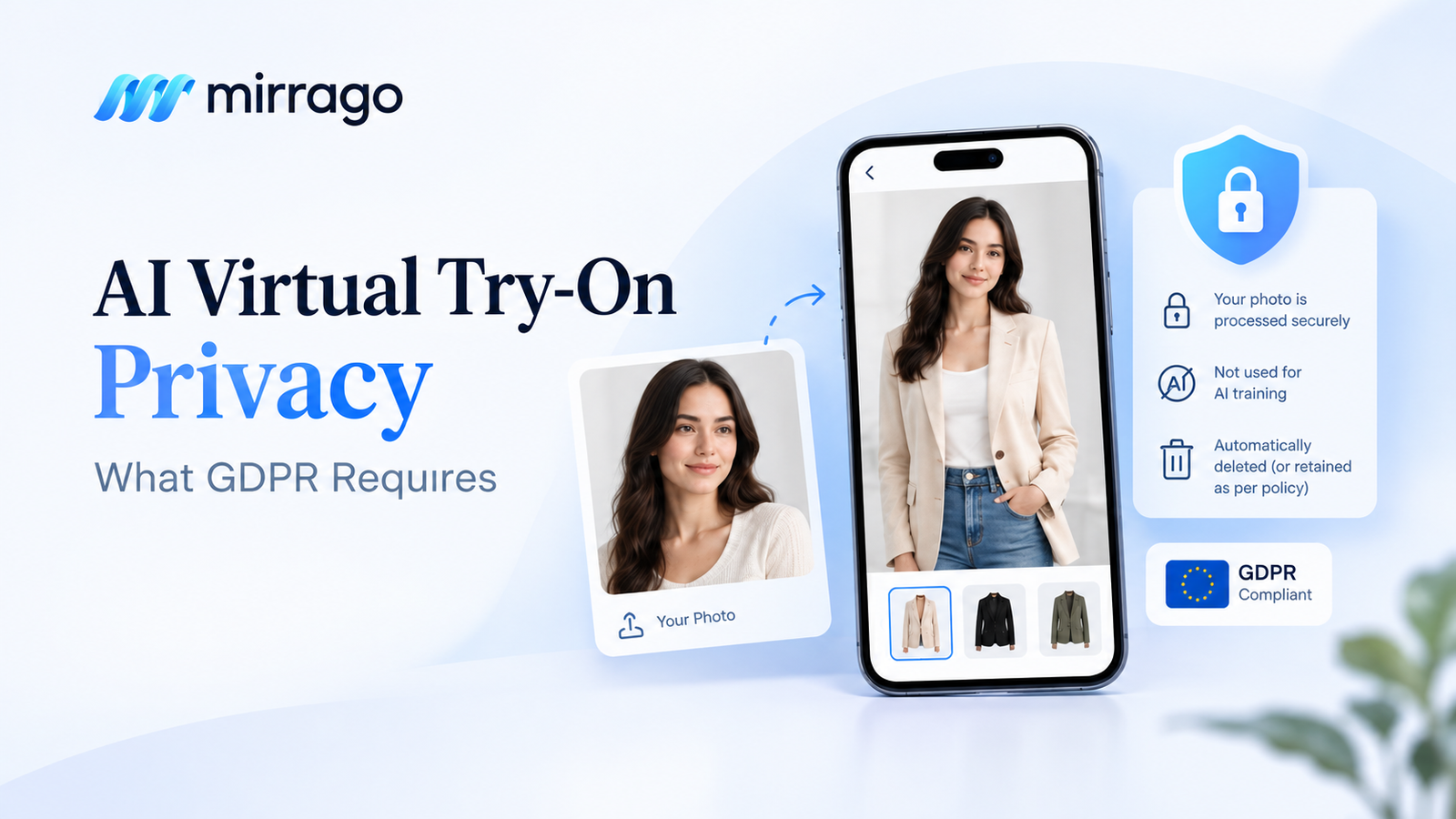
Mirrago platform is built around this kind of approach. According to Mirrago's current site, the emphasis is on secure photo processing, automatic deletion of photos after the try-on session, and a policy against using customer photos to train AI models, alongside a general GDPR-focused approach to privacy.
For a fashion brand, realism of the try-on image is important, but so is the understanding of what could happen to the data in the image. A provider that has a clear understanding of both is a safer play long-term than one that just discusses visuals.
(Before publishing this section on your own site, double-check it against Mirrago's current privacy policy and technical documentation to make sure it matches exactly.)
AI Virtual Try-On Privacy Checklist
Before integrating a virtual try-on platform, it helps to have a short list on hand:
What customer data is collected?
Why is the photo processed?
What is the retention period?
Is the photo used to train AI models?
Who can access the image?
Are third-party processors involved?
How is the data secured?
How can customers request deletion?
Is the privacy notice kept up to date?
Is a Data Processing Agreement required?
Conclusion
AI virtual try-on starts with one thing: the customer’s photo. That makes privacy an important part of the experience, not something to think about later. Customers should be able to understand what data is collected, why it is needed, how long it is kept, and who can access it.
The approach is simple: collect only what you need, use it for a clear purpose, protect it, delete it when it is no longer needed, and be transparent with customers. When brands make privacy part of the try-on experience, they can build trust while giving shoppers a better way to explore fashion online.
Call To Action
Bring AI virtual try-on to your store without compromising customer privacy.
See how Mirrago combines AI-powered try-on with a privacy-focused approach.
Get started with Mirrago to see how it works.
FAQs
1. Is AI virtual try-on GDPR compliant?
AI virtual try-on can be used in a GDPR-compliant way, but compliance depends on how customer photos are collected, processed, stored, shared, and deleted. Businesses need to assess the specific processing and ensure appropriate privacy measures are in place.
2. Are photos uploaded to AI virtual try-on personal data?
Yes, in most cases. If a photo can identify the person shown, it may be considered personal data under GDPR. This means businesses need to consider how the image is collected, used, stored, and protected.
3. What happens to photos uploaded to AI virtual try-on?
Typically, the photo is uploaded, securely processed by the AI system, combined with the selected garment, and used to generate the virtual try-on result. Afterward, the photo and generated image may be deleted or retained depending on the provider's data policy.
5. Are customer photos used to train AI virtual try-on models?
It depends on the provider. Businesses should ask whether customer photos are used to train or improve AI models and understand how that use is explained and documented.
6. How can fashion brands protect customer photos in virtual try-on?
Fashion brands should collect only the data they need, clearly explain how photos are used, limit retention, use appropriate security measures, control access, and understand whether third-party providers process the images.
7. What should fashion brands ask an AI virtual try-on provider?
Brands should ask where customer photos are processed, how long they are stored, whether they are used for AI training, who can access them, whether third-party providers are involved, and what GDPR documentation is available.
8. How does AI virtual try-on handle customer photos?
A typical AI virtual try-on system receives a customer's photo, processes it with the selected garment, generates the try-on result, and then handles the original and generated images according to its retention and deletion policy.