Black Friday Deals: Boost Sales and Reduce Returns with Virtual Try On
Your Black Friday deals might get shoppers to click, but what happens next determines whether those clicks turn into profitable sales.
Shoppers are ready to spend. US consumers spent a record $11.8 billion online on Black Friday 2025, up 9.1% from the previous year, according to Adobe Analytics. Adobe expects online spending to reach $12.9 billion this year, with mobile shopping continuing to play a major role.
But fashion brands face a challenge that discounts alone cannot solve. A shopper browsing a jacket on their phone may like the design and price but still wonder how it will look on them. That uncertainty can lead to abandoned carts, lost sales, or purchases that end up being returned in December.
This is where virtual try-on makes a difference. It lets shoppers see how clothing looks on them before they buy, helping them shop with more confidence.
In this guide, we'll explore how fashion brands can use virtual try on to turn more Black Friday visitors into buyers, improve the shopping experience, protect profit margins, and get their Shopify or WooCommerce stores ready before November 27.
Why Black Friday deals alone don't close fashion sales
A discount brings shoppers to your product page. It doesn't remove the doubt that keeps them from checking out. Here's what usually gets in the way:
Everyone offers discounts at the same time:
During Black Friday, shoppers see similar offers across multiple stores. When several brands offer 40% off, price alone may not be enough to convince customers to choose your store. You need to give shoppers another reason to buy from you.Product photos don't answer every question:
A model photo shows how an outfit looks on someone else, but shoppers still want to know how it might look on them. This uncertainty can make them hesitate before purchasing.Doubt empties the cart:
Shoppers who don't know what to do save the item “for later,” open a competitor's tab, and rarely return to the original website.Hype turns into regret:
In a Tesco Mobile survey of 2,000 adults, almost 4 in 10 admitted regretting Black Friday impulse buys, and clothing topped the list of regretted purchases.
For store owners, the real cost of an uncertain purchase goes beyond losing a sale. It can lead to refunds, return shipping expenses, additional handling, and reduced profit margins. A successful Black Friday strategy should focus not only on attracting shoppers with discounts but also on helping them feel confident about what they are buying.
The hidden cost of Black Friday: returns
A Black Friday sale isn't finished when the order ships. It's finished when the customer keeps it.
The National Retail Federation's 2025 returns report puts numbers on the risk:
17% of retail sales were expected to be returned in 2025, compared with 14% in 2024.
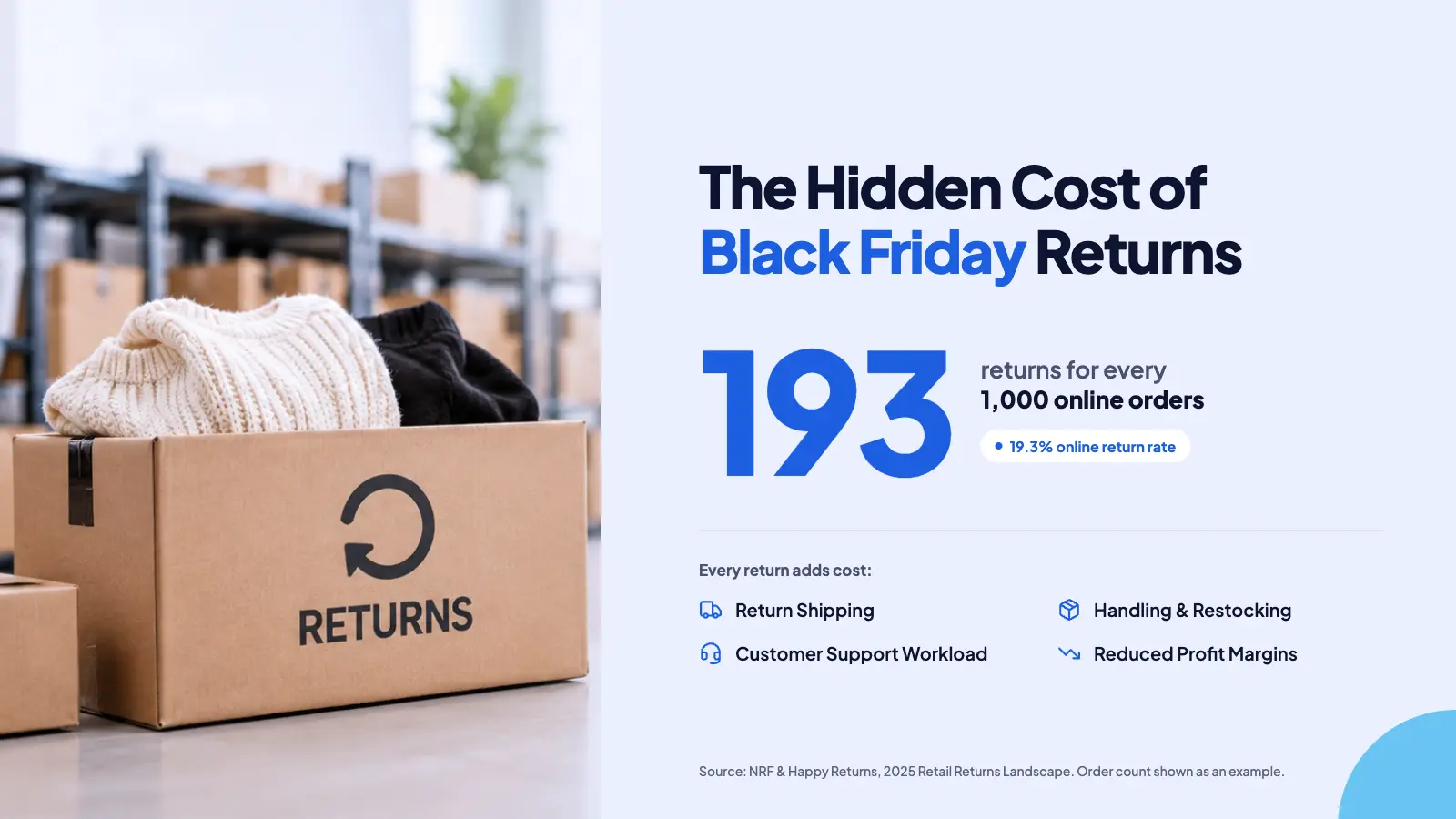
Online return rates were higher. An estimated 19.3% of online sales were expected to be returned, compared with 15.8% of in-store sales.
Imagine a store ships 1,000 orders over Black Friday weekend. If returns follow the 19.3% online average, around 193 orders could come back in December, when your team is already managing the busy holiday season.
Each of those returns costs more than the refund:
Reduced profit margins: Return shipping, handling, and restocking costs can reduce the profit left after a discounted sale.
Missed resale opportunities: Products may arrive back after the Black Friday sale has ended, making it harder to resell them at the original price.
More customer support work: Your team may need to handle returns and refund requests while managing new orders during the holiday season.
Lower overall profitability: A strong sales weekend can become less profitable when a large number of orders are returned later.
To reduce avoidable holiday returns, help shoppers make confident decisions before they place an order. Show them what they are buying and give them a better idea of how the product may look on them. This can improve the shopping experience and reduce uncertainty without requiring you to spend more on advertising.
How virtual try on turns Black Friday traffic into sales
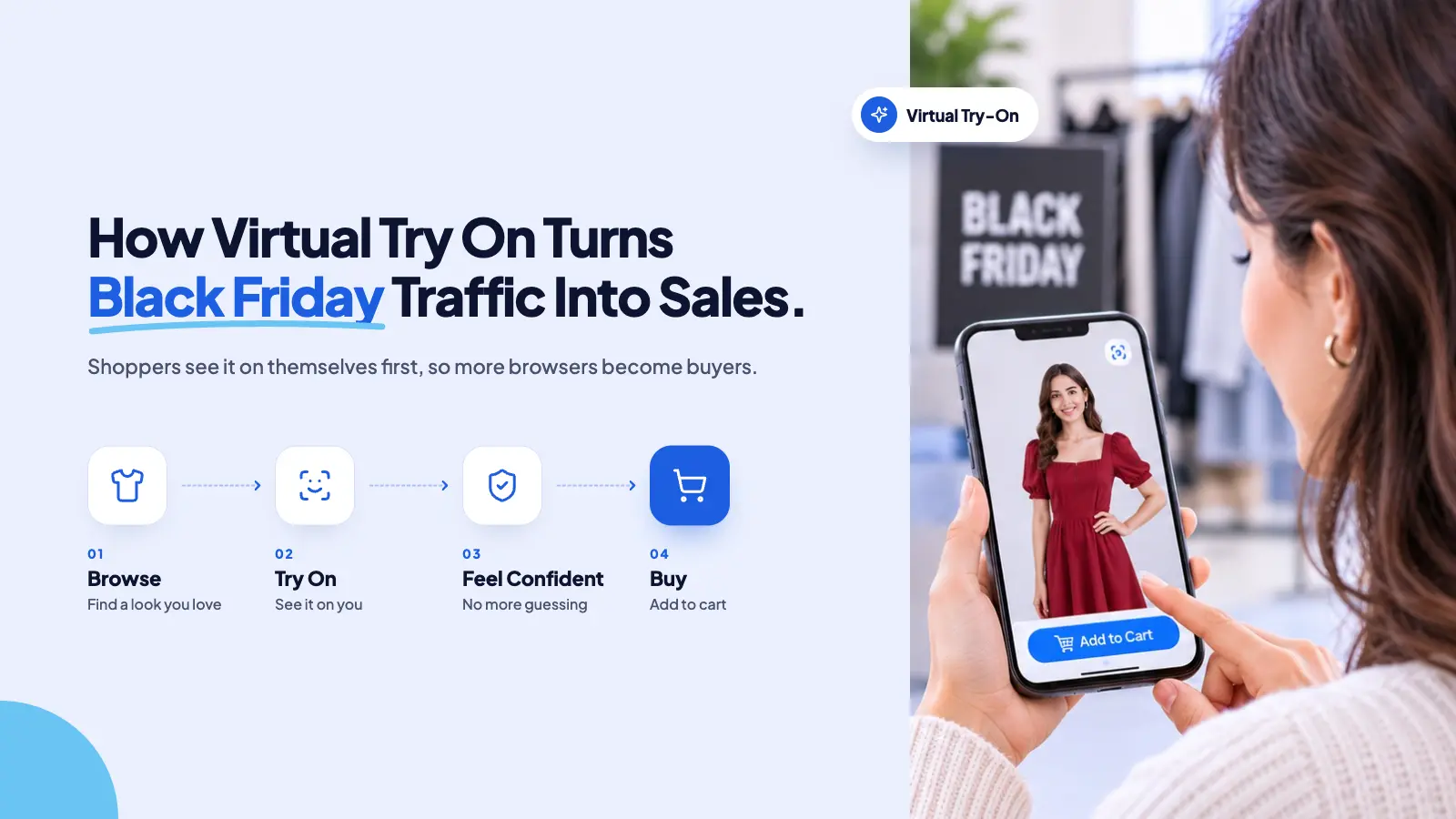
Virtual try on is a service that enables a customer to upload a picture and view the item on themselves prior to purchase. It's like having a sales assistant say, “How will this look on me?” to every passerby from 3 am until the busiest hour on Black Friday.
Here's what it changes for your store:
An increasing number of browsers make a move toward buyers. Once the piece is on its own, you will no longer experience hesitation and will have increased sales traffic to checkout.
Fewer unexpected returns: Virtual try on is a specialized system. No one doubts that virtual try on is a sharply targeted system. 69% of shoppers surveyed revealed that they were less likely to make returns after using artificial intelligence during their shopping.
Bigger baskets: If the “try on” is available, they can try on a top, trousers, outerwear, and accessories in one go, which means that people will want to add another top and trousers, for example, or several layers of outerwear.
Sustains customers' interest for longer: Shoppers are able to interact with the experience of shopping, with virtual try-on helping them to explore shopping possibilities rather than move on to another shop.
It works on phones: Adobe predicts 57.4% of online holiday shopping will take place on mobile this year, making the few taps it takes to complete the try on a big deal.
A benefit other than discounts: Focus on giving consumers more value, like samples of a product or a product in action, instead of price guarantees.
How Tsarmoire uses virtual try on
Tsarmoire, an online fashion store selling dresses, tees, and trousers, added Mirrago virtual try-on to its WooCommerce product pages. In the first 30 days
182 shoppers started a try-on.
Sessions with a try-on averaged 11.3 pages viewed, compared with 3.7 across the whole store.
Want to see it on your own catalog first? Start free with Mirrago for Brands and test it on a few products before the sale.
Yes, you can still launch before Black Friday.
It doesn't take months, though, to add virtual try-on. Mirrago is integrated with the platforms that most fashion stores are already using, and there are no setup fees, with setup taking less than an hour.
Shopify virtual try-on
Install the Mirrago extension from your Shopify admin, then turn on try-on for the products you want to feature. Our Shopify extension guide walks through each step.
WooCommerce virtual try-on plugin
On WordPress, add the Mirrago virtual try-on plugin the same way you'd add any other plugin, then enable it for your sale products. A standard WooCommerce store needs no custom code.
Custom stores and the REST API
Custom builds connect through the Mirrago REST API, using the developer documentation. Allow a little extra time, since your team will place and test the button themselves.
Not sure what to look for in a tool? Read How to Choose a Virtual Try-On Tool first.
Your Black Friday Virtual Try-On Launch Plan
Timeline | Action Plan |
Nov 21 to 22 | Create a free business account, install the Shopify extension or WooCommerce plugin (or connect the API), and turn on virtual try-on for your hero products. |
Nov 23 | Test try-on on mobile and desktop, on product pages and sale collections. |
Nov 24 to 25 | Announce the new feature through email, social media, and website banners, and make sure your support team knows how it works. |
Nov 26 | Run a final mobile test. Adobe expects a record 63% of Thanksgiving online spending to come from mobile devices. |
Nov 27 to 30 | Go live for Black Friday and Cyber Monday, and watch try-on use and add-to-cart rates. |
December | Review your return data and compare products with virtual try-on against those without it. |
Short on time? Start with 10 to 20 hero products and add the rest after the sale. Good candidates are:
Best sellers that will draw the most traffic
Your deepest discounts, where margin is thinnest
Items that often come back because they "looked different than expected"
How to promote try on during Black Friday week
A try-on button only helps if shoppers know it's there:
Product pages: Make sure the “Try it on” button is next to “Add to cart” for all sale products.
Include the line in your sales emails that reads, "See it on you before buying," in your emails that lead to the sale collection.
Banner for Site Discount: "Try on first; we guarantee up to 40% off.
Social media: publish a short video of a real try on from taking the picture to showing the outcome.
Try on Friday: ask your customers to shop with the hair on, then share their favorite looks with your hashtag! It transforms your Black Friday discounts into content that your consumers wish to share.
Retargeting ads: test out “Try it on” vs “Shop now” CTA in comparison to purchasers who viewed but didn't buy.
For more ways to lift sale-week conversions, see our Top 10 Black Friday Sales Tips for Clothing Brands.
Black Friday try-on launch checklist
You will need to create an account and connect the Shopify account, WooCommerce, or API to your business account.
Try-on turned on for hero products
Next to the "Add to cart" option, which is known as the “Try it on” button.
Works both on mobile and on desktop
Try on in sale emails, on social posts, and on site banners
Support team briefed
How to measure results after Black Friday
Don't use the number of clicks on the button as a measure of the "try-on." Please judge by orders and returns. Arrange these comparison dates ahead of November 27 so there's time to have the numbers waiting for the day of the sale:
Share of try-on users in the group of visitors on the product page the hero product is placed on.
Add-to-cart and conversion rate: customers who added products to their cart compared to those who did not add the same products.
Average order value: whether try on customers purchased more items in their orders.
Return rate by product: try-on and similar products without try-on (December/January).
Return reasons: Pre- & post-launch rates of "looked different than expected."
Return windows may extend into January, so wait it out for the bigger picture. When you think in this context, the numbers display your best Black Friday offer, whether to try on the offer to your entire customer base or if the offer was profitable.
Win Black Friday with confidence, not just discounts.
This year, every fashion store will have Black Friday deals. The stores that come out ahead will be the ones that help shoppers feel sure before they pay. Virtual try-on does exactly that: more of your traffic turns into orders, and more of those orders stay sold.
You still have time. Pick your hero products, install Mirrago this weekend, and let shoppers see the deal on themselves before they buy.
Start free with Mirrago for Brands, or book a 30-minute demo if you'd like help choosing products and button placement.
What are the best Black Friday deals for fashion shoppers?
The best Black Friday deals combine attractive discounts with a shopping experience that helps customers choose confidently. For fashion stores, clear product information, strong offers, and virtual try on can make it easier for shoppers to decide what to buy.
How can virtual try on help increase Black Friday sales?
Virtual try on lets shoppers preview how clothing may look on them before buying. By reducing uncertainty and helping customers feel more confident about a product, it can support stronger engagement, add-to-cart activity, and conversions during Black Friday sales.
Can virtual try on help reduce fashion returns?
Virtual try-on can help reduce avoidable returns by giving shoppers a better visual understanding of how a product may look on them before purchase. However, return results vary by product category, store, and customer behavior, so it should be viewed as one part of a broader returns strategy.
Does virtual try on work with Shopify and WooCommerce?
Yes. Fashion stores can add virtual try-on to Shopify and WooCommerce using compatible integrations or plugins. The setup process depends on the platform and the specific implementation, so stores should test the experience on their key products before launching a Black Friday campaign.
Is it too late to add virtual try on before Black Friday?
Not necessarily. Fashion stores can start with a small group of high-priority products, such as best sellers or heavily promoted items, and test the experience before expanding it across the catalog. This can make a Black Friday virtual try-on launch more manageable.